Fuel Science
What Creatine Actually Does in a Muscle Cell
Not a stimulant, not a hormone, not a protein. Creatine is a battery for the first ten seconds of hard effort.
Creatine is the most studied sports supplement in existence — several hundred peer-reviewed human trials, and a rare case where the marketing and the science point in roughly the same direction.
It's also widely misunderstood. It isn't a stimulant, a steroid, or a protein. Here's what it actually does.
The energy system it works on
Muscle contraction is powered by ATP — adenosine triphosphate. When a muscle fires, ATP loses a phosphate group and becomes ADP, releasing energy.
The problem is that muscle stores very little ATP. Enough for roughly one to two seconds of maximal effort. After that it has to be regenerated, and there are three systems that do it at different speeds:
| System | Duration | Speed |
|---|---|---|
| Phosphocreatine | ~1–10 seconds | Fastest |
| Anaerobic glycolysis | ~10 s – 2 min | Fast |
| Aerobic (oxidative) | 2 min onward | Slow, sustainable |
The first system is where creatine lives. Phosphocreatine stored in muscle donates its phosphate group to ADP, regenerating ATP almost instantly — no oxygen required, no waiting.
Supplementing creatine increases the amount of phosphocreatine your muscles hold. Typical increases are around 20–40% above baseline, with more room in people who start lower.
What a bigger tank actually buys you
Not strength directly. What it buys is more work before fatigue in short, hard efforts — and more complete recovery between them.
Concretely: if you were getting eight reps at a given weight, you might get nine or ten. If your fifth sprint was slower than your first, the gap narrows. Over weeks of training, that additional accumulated volume is what drives the strength and hypertrophy differences seen in trials.
This is the mechanism worth internalising: creatine doesn't make you stronger, it lets you train harder, and training harder makes you stronger. Without the training stimulus, the effect largely doesn't materialise.
Where it helps most and least
Strongest evidence: resistance training, repeated sprints, jumping, throwing, and any sport built on short maximal efforts with incomplete recovery. Hockey shifts, rugby, sprinting, Olympic lifting, football.
Weak or absent: steady-state endurance. A marathon runs on the aerobic system, and creatine does nothing there except add about a kilogram of intracellular water you then have to carry. For most endurance athletes the effect is neutral at best.
Emerging and less settled: cognition, particularly under sleep deprivation; recovery from muscle damage; bone density in older adults when combined with resistance training. Interesting, less established than the performance data.
Your body already makes it
Worth knowing, because it reframes what supplementation is doing.
Your liver and kidneys synthesise roughly a gram of creatine a day from three amino acids — arginine, glycine and methionine. You also get some from food, almost entirely meat and fish, at around 1–2 g per pound of red meat.
Between those two sources most omnivores sit at perhaps 60–80% of the muscle's maximum storage capacity. Supplementation fills the remainder.
This is why people who eat little or no meat tend to start lower and respond more — covered in creatine for vegans and vegetarians.
Where our gummies sit
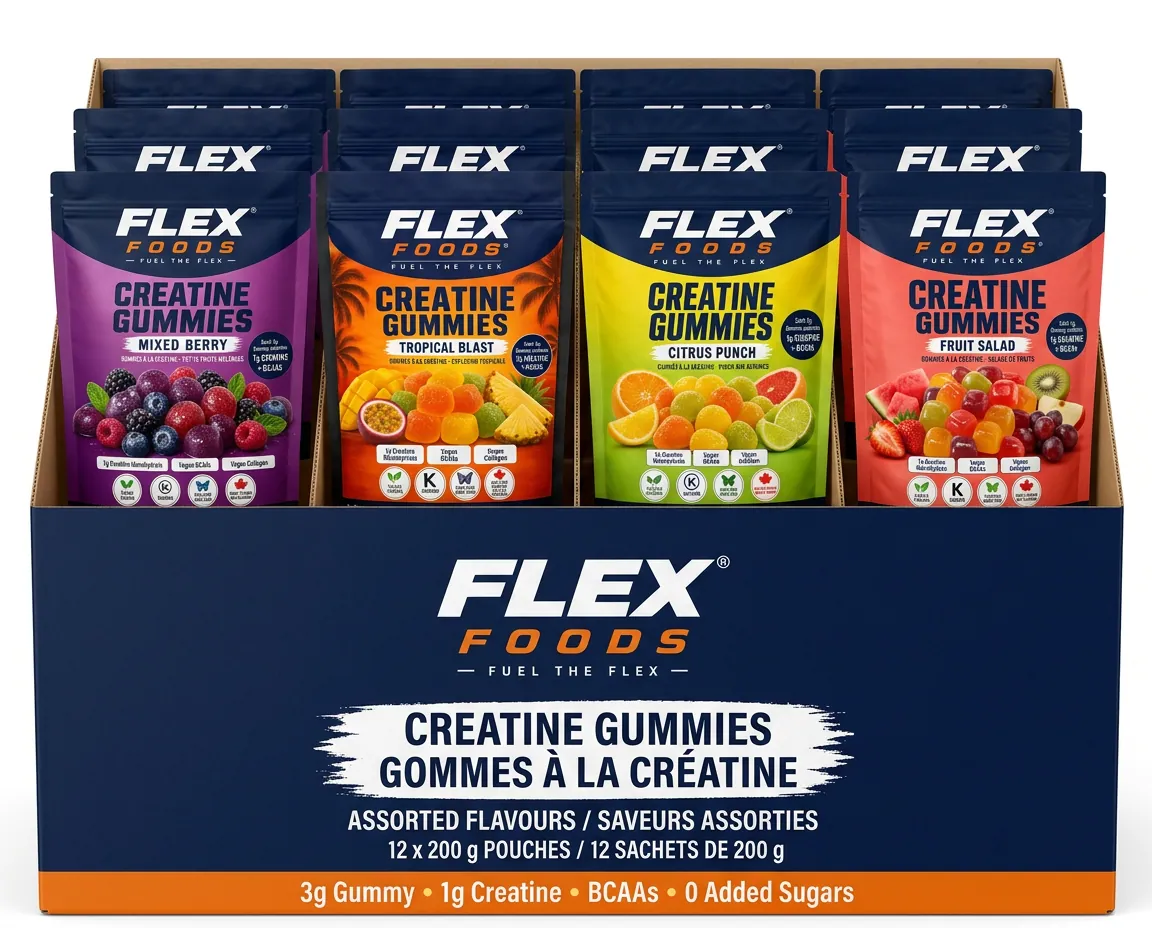
Each 3 g gummy contains 1 g of creatine monohydrate. The label directs three gummies daily, which is 3 g of creatine per day — the low end of the commonly cited 3–5 g maintenance range.
Three gummies is 45 calories, 9 g of sugar alcohols and 15 g of total gummy. A 200 g pouch is 22 daily servings.
Two honest notes. Three grams a day will saturate muscle stores, but more slowly than 5 g and more slowly still than a loading protocol — see how much creatine per day. And a loading phase is impractical in gummy form for reasons we work through in the loading post.
What it won't do
Being clear, since creatine gets credited with a lot it doesn't deliver.
- It isn't a stimulant. No acute energy effect. You won't feel it the way you feel caffeine, and nothing is wrong if you don't.
- It isn't a hormone or a steroid. It's an amino acid derivative with no structural or functional similarity. See is creatine a steroid.
- It isn't a protein source. Our panel declares 0 g protein, which is accurate — creatine doesn't contribute meaningfully to protein intake.
- It won't work without training. The performance literature is built on supplementation alongside a training programme.
- It doesn't work for everyone. Roughly a fifth to a third of people show little response, usually because their baseline stores are already near capacity. See non-responders.
The realistic expectation
A few extra reps. Slightly better repeated-sprint performance. Around a kilogram of scale weight from intracellular water in the first few weeks, which is not fat and not subcutaneous bloating.
Modest, real, and unusually well evidenced for a supplement. That's the honest pitch.
This is general information about a natural health product, not medical advice. If you have a kidney condition, take prescription medication, or are pregnant or breastfeeding, talk to your doctor or pharmacist before starting creatine.