
Nutrition 101
Creatine for Vegans and Vegetarians: Why Your Baseline Is Lower
Dietary creatine comes almost entirely from meat and fish. If you eat neither, you start lower — and often respond more.
This is the population where creatine supplementation has the clearest rationale, and it's underdiscussed.
Most creatine research is done on omnivores. But the effect size depends heavily on where you start, and vegetarians and vegans start meaningfully lower.
Why plant-based diets deliver almost no creatine
Creatine is found in vertebrate muscle tissue. That's essentially it.
Red meat and fish carry roughly 1–2 g per pound raw, and some is destroyed by cooking — prolonged high-heat cooking converts a portion to creatinine. Poultry has less. Dairy and eggs contain trace amounts. Plants contain essentially none.
So a typical omnivore eating meat most days gets perhaps 1–2 g of dietary creatine daily. A vegan gets close to zero.
What that does to muscle stores
Your body synthesises roughly a gram of creatine daily in the liver and kidneys from arginine, glycine and methionine. That endogenous production continues regardless of diet, and it's partly why vegetarians aren't creatine-deficient in any clinical sense.
But endogenous synthesis alone doesn't fill the tank. Studies measuring muscle creatine content have consistently found lower resting stores in vegetarians and vegans compared with omnivores.
Lower baseline means more headroom. And more headroom generally means a larger response to supplementation — which several studies comparing vegetarians and omnivores have found, both for muscle creatine increases and, in some work, for performance and lean mass outcomes.
This is one of the few cases in sports nutrition where a supplement can be said to address a genuine dietary gap rather than pushing an already-adequate system.
The cognitive angle
Worth flagging separately because it's interesting and less settled.
The brain also uses creatine, and some research on cognitive effects has found the clearest results in vegetarian participants — the group with the most room to move. Studies have reported improvements on memory and processing tasks in vegetarians that were smaller or absent in omnivores.
Being careful here: this literature is smaller, effect sizes vary, and it hasn't converged the way the muscle performance data has. It's a reasonable additional consideration for a plant-based person, not a claim to build a decision on. Our fuller treatment is in creatine and brain energy.
The obvious question: is supplemental creatine vegan?
Yes, when it's synthetic — and virtually all commercial creatine monohydrate is.
Creatine monohydrate is manufactured through chemical synthesis, typically from sarcosine and cyanamide. It is not extracted from animal tissue. The finished molecule is identical to what your body makes and what's found in meat, because it's the same compound.
Where a vegan does need to check is the delivery format rather than the creatine itself:
- Capsules frequently use gelatin, which is animal collagen. Look for vegetable cellulose (HPMC).
- Gummies traditionally use gelatin as the gelling agent. Pectin-based gummies are the plant alternative.
- Flavoured powders occasionally contain dairy derivatives.
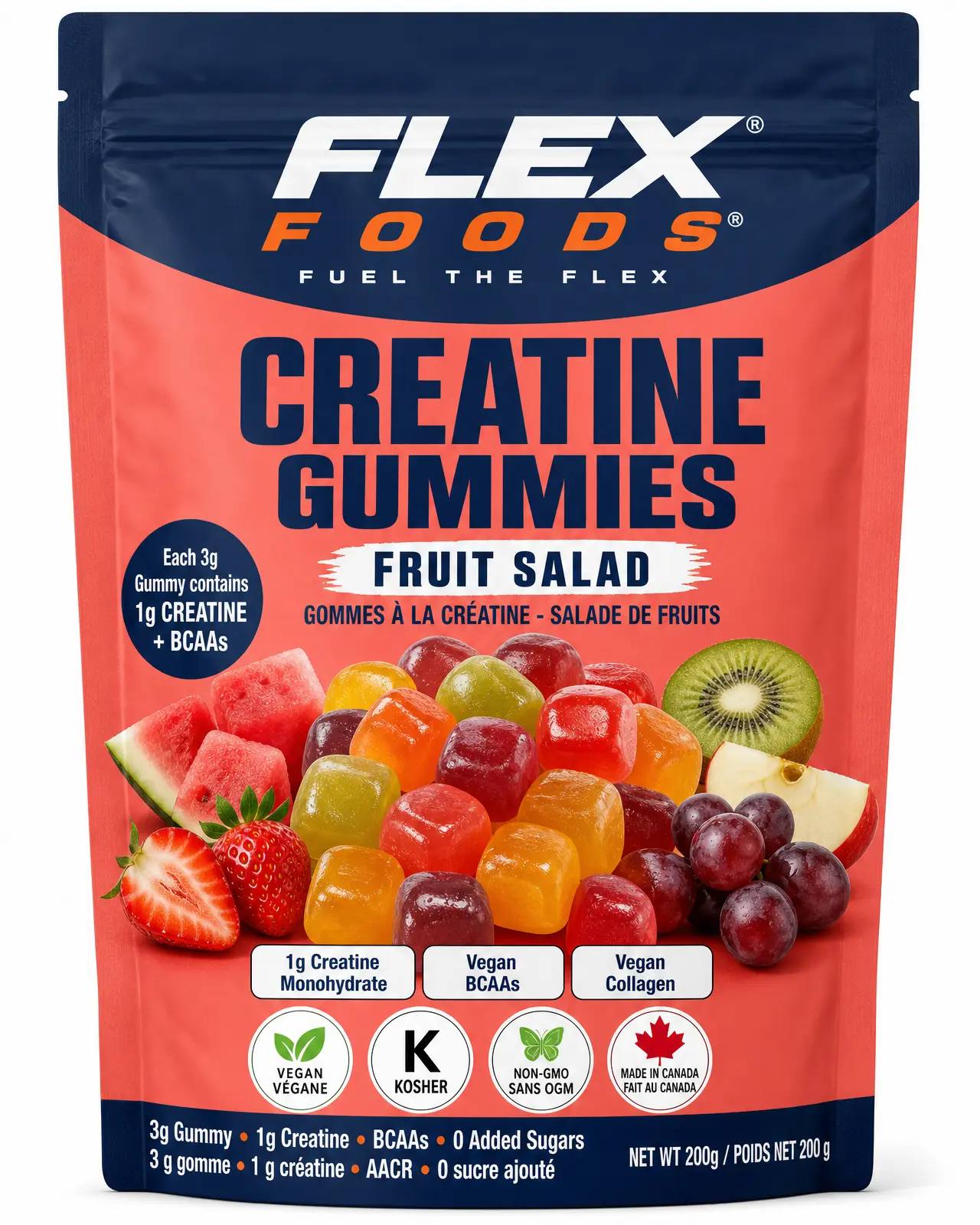
Our gummies use pectin rather than gelatin, which is why they're vegan. That's a formulation choice with real consequences — pectin sets differently and produces a different texture, covered in pectin vs gelatin.
What else plant-based eaters should be watching
Creatine is one item on a short list, and honestly not the most important one. Worth naming the others:
- Vitamin B12. Not available from plants. Requires fortified foods or a supplement — this one is non-negotiable.
- Vitamin D. Difficult from food generally, and negligible skin synthesis at Canadian latitudes for much of the year.
- Iron. Plant iron is non-heme and less well absorbed. Test rather than guess.
- Omega-3 (EPA/DHA). Algae-based supplements are the direct plant source.
- Iodine, zinc, calcium. Worth attention depending on the diet's composition.
If you're plant-based and choosing what to supplement, B12 comes first and it isn't close. Creatine is a performance and possibly cognitive addition, not a deficiency correction.
Practically
Three grams daily from three of our gummies is a maintenance dose, and for someone starting from a lower vegetarian baseline it will take a little longer to fill a slightly emptier tank. Four weeks is a reasonable expectation. Larger individuals may be better served at the top of the 3–5 g range — see how much creatine per day.
General information about a natural health product, not medical advice.