
Snacking
Protein Chips vs Rice Cakes: A Nutrition Comparison
Rice cakes are the original air-puffed snack. Here's what adding 12 grams of protein actually changes.
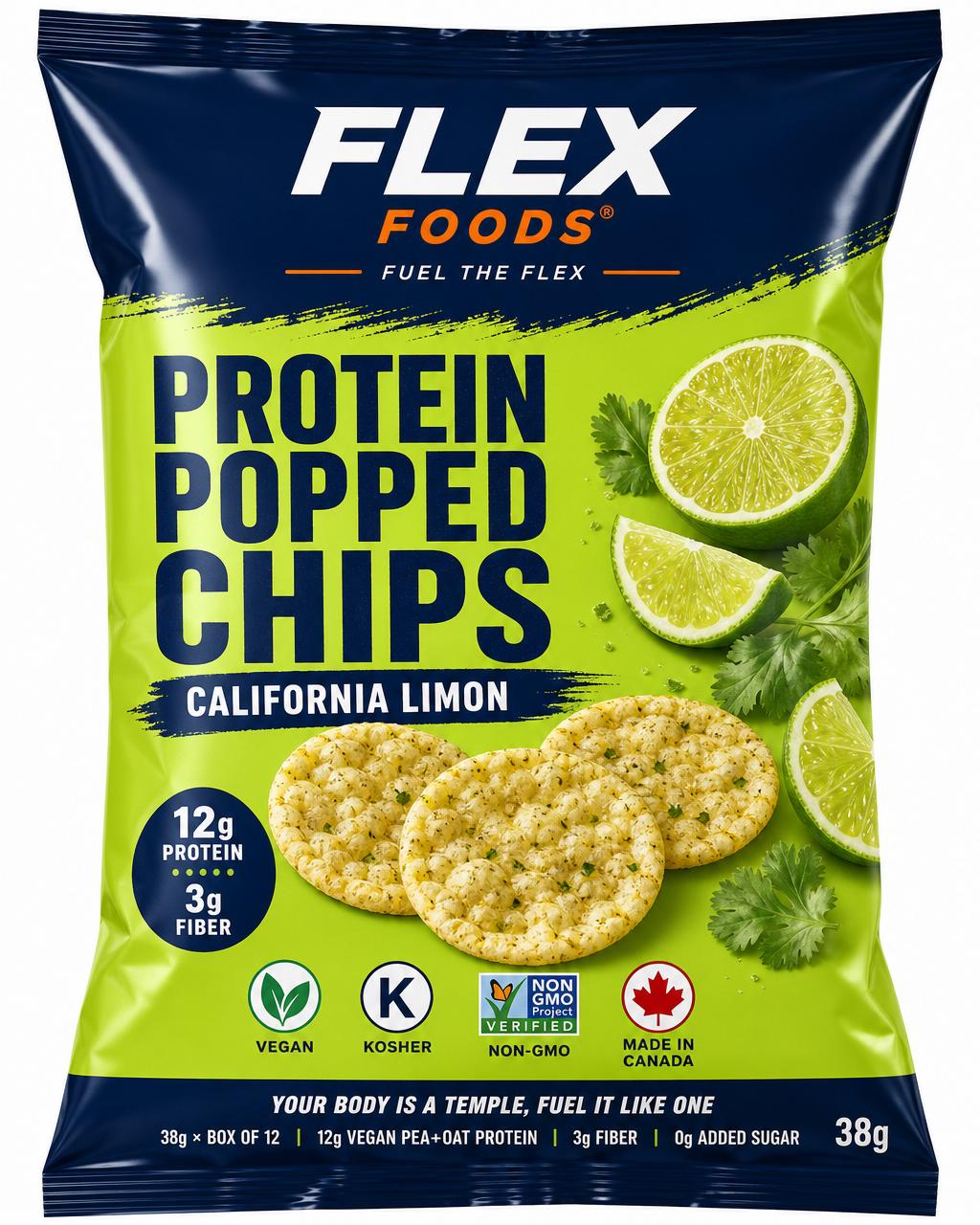
Rice cakes and popped protein chips are made by nearly the same process — a grain heated under pressure in a mould until trapped water flashes to steam and expands the structure. The rice cake got there first, by decades.
So the comparison is unusually clean. Same physics, different dough.
The numbers, normalised
Rice cakes are typically sold as 9 g discs, so we've scaled to a comparable 38 g serving — roughly four plain cakes.
| Per ~38 g | Plain rice cakes | Protein Popped Chips |
|---|---|---|
| Calories | ~148 | 150 |
| Protein | ~3 g | 12 g |
| Fibre | ~1 g | 3 g |
| Fat | ~1 g | 4 g |
| Sodium | 0–100 mg | 200 mg |
| Protein per 100 cal | 2.0 g | 8.0 g |
Nearly identical calories. Four times the protein. That's the entire difference, and it comes from the dough rather than the process.
Where rice cakes genuinely win
Three things, and they're real.
Cost. Not close. Plain rice cakes are among the cheapest packaged snacks available, typically a fraction of the per-gram cost of a protein snack. If cost per calorie is your constraint, rice cakes win outright.
Sodium. Unsalted versions carry essentially none. Ours is 200 mg per bag, 9% of the daily value — moderate rather than low, and we don't qualify for a low-sodium claim. If you're managing sodium closely, that matters. See sodium and snack frequency.
Neutrality. A plain rice cake is a blank platform. You can put anything on it — nut butter, avocado, hummus, tuna — without a seasoning arguing with the topping. A seasoned chip is a finished thing.
The glycaemic difference
Worth knowing, and it's the least obvious point here.
Plain rice cakes are made from puffed rice with essentially nothing else — no protein, negligible fat, minimal fibre. That combination, plus a highly gelatinised and porous starch structure with enormous surface area, makes them among the more rapidly digested carbohydrate foods available. They routinely appear at the top of glycaemic index tables.
The usual caveats apply. Glycaemic index is measured on 50 g of available carbohydrate eaten alone, portions and combinations in real life differ, and individual glucose responses vary substantially between people. But the mechanism is straightforward: nothing in a plain rice cake slows digestion.
Protein, fat and fibre all slow gastric emptying, so a chip carrying 12 g of protein and 3 g of fibre produces a flatter curve than a plain rice cake of the same calories. Detail in reading carbs, fibre and net impact.
The practical version of this is familiar to anyone who's tried it: two plain rice cakes at 3pm leaves you hungry at 3:40.
The obvious fix, which is also the point
Nobody eats plain rice cakes plain. You put something on them, and what you put on them determines everything.
Two rice cakes with two tablespoons of peanut butter is around 260 calories with 10 g of protein. That's a good snack, and it's more calories than a bag of chips for slightly less protein. Two rice cakes with cottage cheese is around 160 calories with 15 g of protein — better than ours on protein per calorie, and it needs a fridge.
So the honest framing: rice cakes are a vehicle, protein chips are a snack. If you're at home with a fridge and thirty seconds, rice cakes plus a topping is excellent and cheaper. If you're at a desk, in a car, or in a gym bag, a topping isn't happening.
Flavoured rice cakes are a different product
Worth checking rather than assuming. Flavoured versions — caramel, chocolate, barbecue, sour cream — frequently carry added sugar, and some are closer to confectionery than to the plain product's reputation.
Check two lines: added sugars and sodium. The health halo attached to "rice cake" carries over to flavoured versions in a way the ingredient list often doesn't support. Same problem discussed in the veggie straws health halo.
The arsenic point, briefly
Rice takes up inorganic arsenic from soil and water more readily than most crops, and rice cakes are almost entirely rice. Brown rice versions are generally higher, since arsenic concentrates in the bran.
Our chips contain brown rice as the third ingredient, so the same consideration applies to us at a smaller quantity. Health Canada monitors rice products and the general recommendation is dietary diversity across grains rather than eliminating rice. Detail in the brown rice question.
The verdict
Rice cakes are cheaper, lower in sodium and more versatile. Protein chips carry four times the protein, three times the fibre and hold you meaningfully longer.
If you'll add a topping, rice cakes win on value. If the snack has to work as-is, they don't.