Snacking
What a Real 'Better-For-You' Snack Aisle Would Look Like
If shelves were organised by protein-to-calorie ratio instead of brand deals, here's what you'd see.
The "better-for-you" section of a Canadian grocery store is not a nutritional category. It's a merchandising one, defined by packaging cues — kraft paper, green type, leaf motifs, words like simple, real and wholesome — rather than by anything measurable.
Which is why you can find, on the same shelf, roasted chickpeas at 8 g of protein and 6 g of fibre, and a fruit-and-nut bar with 22 g of sugar. Both qualify. Neither claim is false.
So: what would a shelf organised by something real look like?
The organising number
Protein per 100 calories. Grams of protein divided by calories, times 100.
It's not a complete measure of nutritional quality — it ignores fibre, sodium, micronutrients and processing — but it has one large virtue: it normalises across serving sizes, which almost nothing else on a package does. Serving sizes aren't standardised between brands, so per-serving figures are close to useless for comparison.
Run it across the snack aisle and the shelf reorganises dramatically.
| Snack | Protein per 100 cal | Fibre per serving |
|---|---|---|
| Greek yogurt, plain 0% | ~17 g | 0 g |
| Roasted edamame | ~9 g | ~7 g |
| Beef or plant jerky | ~8.6 g | 0 g |
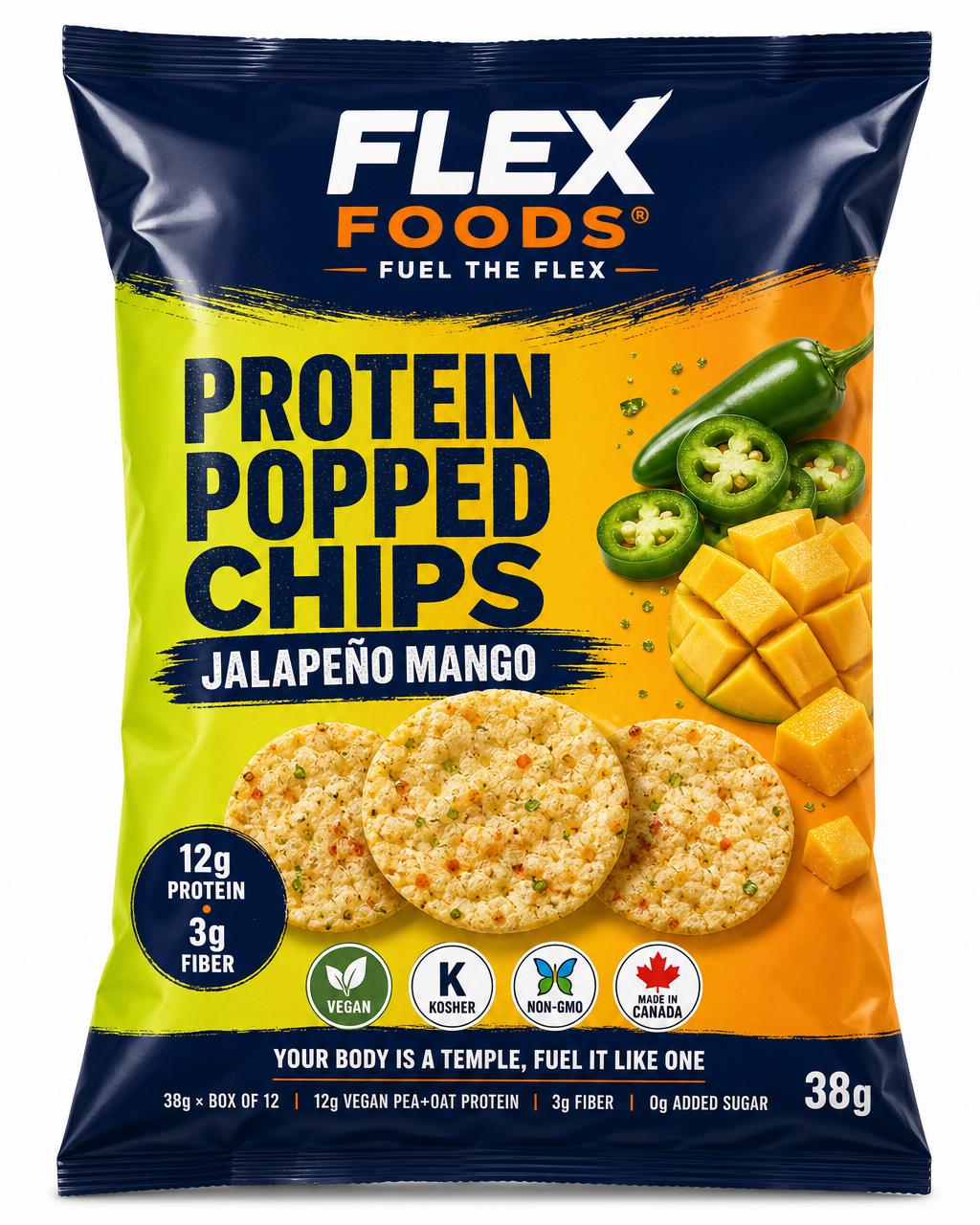
| Protein popped chips | 8.0 g | 3 g |
| Protein bar (good ones) | 7–8 g | 3–10 g |
| Roasted chickpeas | ~4.7 g | ~6 g |
| Cheese and crackers | ~4.0 g | ~1 g |
| Air-popped popcorn | ~3.3 g | ~5.5 g |
| Nuts | ~3.4 g | ~3 g |
| Trail mix | ~2.5 g | ~3 g |
| Rice cakes | ~2.0 g | ~1 g |
| Granola bar | ~1.5 g | ~2 g |
| Veggie straws | ~0.9 g | ~0 g |
| Potato chips | ~0.9 g | ~1 g |
| Fruit snacks | ~0 g | 0 g |
Note where things land relative to their reputations. Veggie straws sit level with potato chips. Granola bars — arguably the archetypal "healthy snack" — sit near the bottom. Popcorn scores modestly on protein and leads on fibre, which is a fair summary of what popcorn is.
Why fibre needs a second column
Protein per calorie alone would rank jerky above popcorn and Greek yogurt above roasted chickpeas, which isn't the whole story.
Protein and fibre produce fullness through different mechanisms on different timescales. Protein works hormonally — GLP-1, peptide YY, cholecystokinin — with a fairly quick, fairly strong response that fades over a couple of hours. Fibre works mechanically and microbially, slowing gastric emptying and adding bulk, and lasting longer.
A snack strong on one and zero on the other is doing half the job. Which is why the honest version of this shelf has two numbers, and why roasted edamame — good on both — arguably tops it. Detail in the 3 g fibre detail.
What the shelf still wouldn't capture
Four things, and they're not minor.
Sodium. Jerky scores well on protein and carries 400–600 mg per small serving. Ours is 200 mg — moderate, not low. A third column would be defensible.
Added sugar. Enormous variance within categories. Some protein bars are essentially confectionery with protein powder in them.
Whole food versus formulated. Nuts and roasted chickpeas score modestly on protein per calorie and bring micronutrients, unsaturated fats and polyphenols that a formulated product doesn't. Ranking by macros systematically undervalues them, and that's a real limitation of the whole exercise.
Whether you'll eat it twice. Adherence dominates everything over any real timeframe, and no shelf arrangement measures palatability.
What regulation could actually fix
Two things, both modest and both achievable.
Standardised serving sizes within categories. Canada publishes Reference Amounts used for nutrition claims, but declared serving sizes on packages can still differ, which makes side-by-side comparison harder than it needs to be. Mandating per-100 g declaration alongside per-serving — as the EU does — would fix most of it in one line of type.
Front-of-package interpretive labelling. Canada now requires a front-of-package nutrition symbol on foods high in saturated fat, sugars or sodium. That's a real intervention, and it's a warning system rather than a ranking — it flags what's high, not what's good.
What to do until then
Ignore the section you're standing in. Run three checks on whatever's in your hand:
- Protein per 100 calories — under 4 is a carbohydrate snack, over 6 is protein-dominant
- Fibre — 3 g or more per serving
- Added sugars — 0 g in a savoury snack
Thirty seconds, and it works on us as well as on anything beside us. Full version in the Canadian high-protein chips buyer's guide.