Snacking
Protein Chips vs Veggie Straws: The Health Halo Problem
Veggie straws are potato chips with a vegetable on the front of the bag. Reading past the halo.
Veggie straws occupy a specific position in the snack aisle: the product parents buy instead of chips, feeling they've made a better choice.
The ingredient list tells a different story, and it's worth walking through — not to be snide about a competitor, but because the pattern repeats across an entire category and recognising it is a transferable skill.
What's actually in them
The ingredient list on a typical veggie straw product runs roughly: potato starch, potato flour, corn starch, sunflower or safflower oil, and then — usually well down the list — tomato paste and spinach powder, plus salt.
Read that ordering carefully. Canadian ingredient lists run in descending order by weight, so the first four entries constitute the overwhelming majority of the product. The vegetables that give the snack its name and its colour appear in quantities small enough to function as colouring.
The green straws are green because of spinach powder. The red ones are red because of tomato. That is the extent of the vegetable content, and it's why the nutrition panel looks the way it does.
The comparison
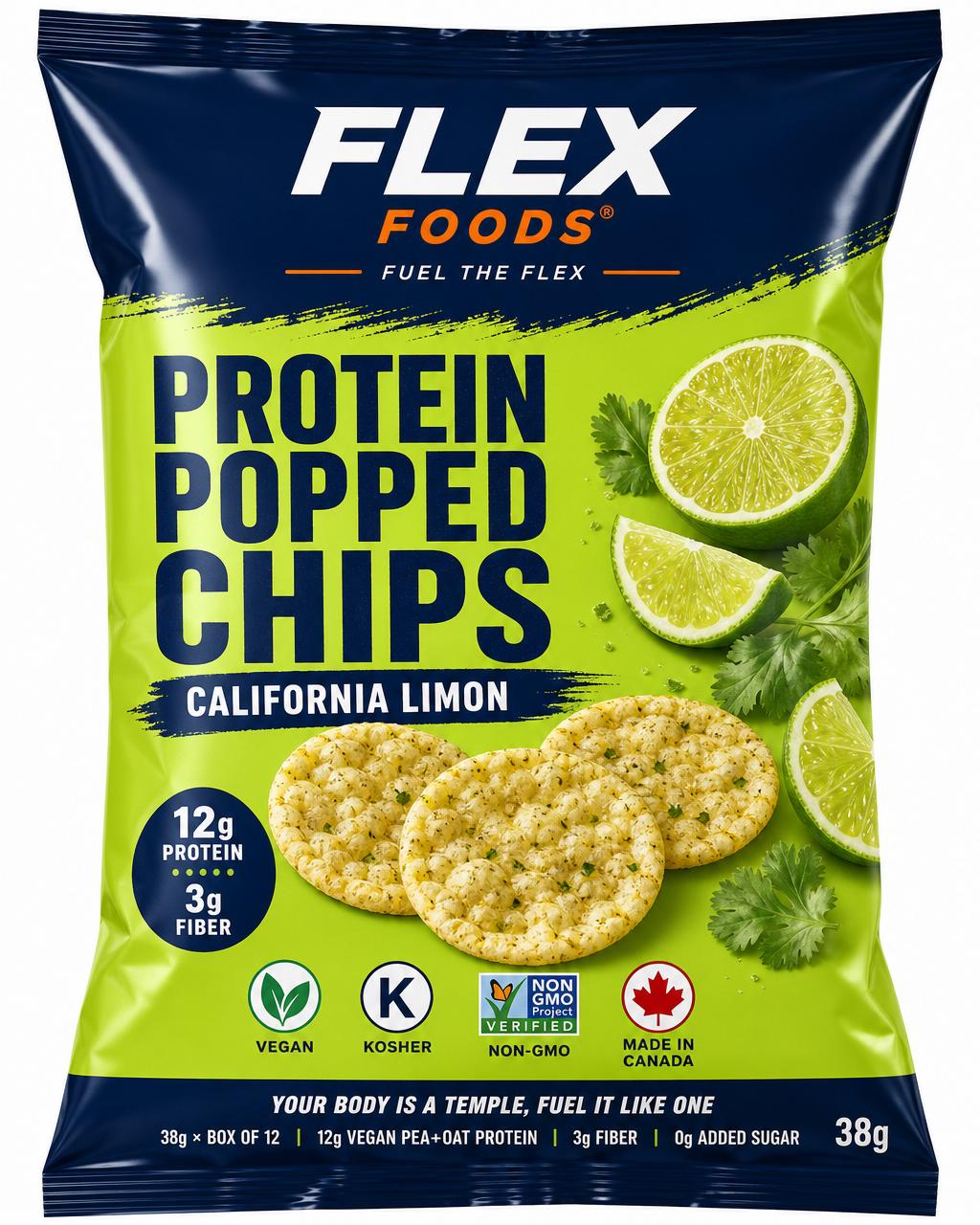
| Per ~38 g | Veggie straws | Potato chips | Protein Popped Chips |
|---|---|---|---|
| Calories | ~175 | ~210 | 150 |
| Protein | ~1.5 g | ~2 g | 12 g |
| Fibre | ~0 g | ~1 g | 3 g |
| Fat | ~9 g | ~13 g | 4 g |
| Sodium | ~250 mg | ~200 mg | 200 mg |
| Protein per 100 cal | 0.9 g | 0.9 g | 8.0 g |
Note the middle column. Veggie straws are modestly better than potato chips on calories and fat, and functionally identical on protein and fibre. They are not a vegetable serving, and nothing about them approximates one.
The improvement over potato chips is real but small. The perceived improvement is large. That gap is the health halo.
How a health halo works
A health halo is when one salient positive attribute — a claim, an ingredient, a colour, a package design — causes people to infer other positive attributes that aren't there.
Research on this is fairly consistent: products carrying a health-associated cue are judged lower in calories than identical products without it, and people tend to eat more of them. The halo can produce a net negative outcome, because the perceived licence to eat more outweighs any modest nutritional improvement.
The cues that trigger it are recognisable once you know them:
- A vegetable, fruit or grain in the product name that's present in trace quantities
- Green packaging, leaf motifs, kraft paper textures
- "Made with real vegetables" — true and uninformative, since any amount qualifies
- Absence claims for things never present — "no cholesterol" on a plant food, "gluten-free" on a potato product
- "Baked not fried" — a real process difference that says nothing about what's in the dough
That last one applies to us. Our bags say "baked, never fried," which is accurate and is a process claim, not a nutrition claim. It predicts lower fat and tells you nothing about protein, fibre or sugar. We'd rather flag that than let it work on you. Detail in popped vs fried.
What to actually check
Three questions that defeat almost every halo, in under thirty seconds:
1. Where does the named ingredient sit in the list? If "vegetables" are in the name and the vegetable powder is sixth, it's a colouring. If a protein product's protein source isn't in the first two positions, it's a garnish.
2. What's the protein per 100 calories? Grams of protein divided by calories, times 100. Under 4 is a carbohydrate snack whatever the front says. Veggie straws score 0.9 — the same as regular potato chips.
3. Is fibre above 1 g? Real vegetable or whole-grain content shows up as fibre. Its absence is diagnostic — you cannot have meaningful vegetable content and 0 g of fibre.
The fair defence of veggie straws
Two things worth saying, because a takedown that ignores them isn't honest.
They're a modest improvement on potato chips: fewer calories, less fat. Not nothing.
And they're genuinely popular with children who won't eat many other things, which has real value to a parent at 4pm on a Tuesday. A snack that gets eaten is worth more than a nutritionally superior one that doesn't — an argument we make about our own product in snacks that taste like punishment.
The objection isn't to the product. It's to being sold as a vegetable.
The one-line version
Veggie straws are a slightly better potato chip. If you want a snack with vegetables in it, eat vegetables; if you want protein, check protein per 100 calories. The front of the package is not where either answer lives.