Snacking
Lunchbox Protein: Snacks Kids Will Actually Trade For
The lunchbox economy is ruthless. Getting protein past the trade table, the nut ban, and a nine-year-old's opinion.
Packing a lunch involves three separate negotiations. One with school policy, one with nutrition, and one with a child who has strong views and access to a trading market you can't see.
Most lunchbox advice handles the second and ignores the other two, which is why so much well-intentioned food comes home uneaten.
Why protein matters in a school lunch
Children's protein requirements per kilogram of bodyweight are higher than adults' during periods of growth, and adolescents in a growth spurt sit at the top of that range. In practice most Canadian children get adequate protein — the more common gap is distribution: very little at breakfast, very little at lunch, and most of the day's protein at dinner.
That matters for the afternoon. A lunch that's largely refined carbohydrate — white bread, fruit snacks, a juice box, crackers — produces a glucose rise and dip, and the dip lands squarely in the afternoon teaching block. Adding protein and fibre flattens that curve.
To be clear about the limits: this is general nutrition information, and a child with specific dietary needs, a growth concern or a medical condition should be discussed with a paediatrician or a registered dietitian rather than a blog.
The school policy problem
Read your school's actual policy rather than assuming, because they vary considerably between boards and even between schools in the same district.
Nut restrictions are the most common. Many Canadian schools are nut-free or nut-aware, which rules out peanut butter, most nut bars, and a lot of trail mix. Some extend to sesame, and increasingly to other priority allergens.
Some schools restrict specific ingredients beyond allergens — sweetened drinks, confectionery, occasionally anything requiring reheating.
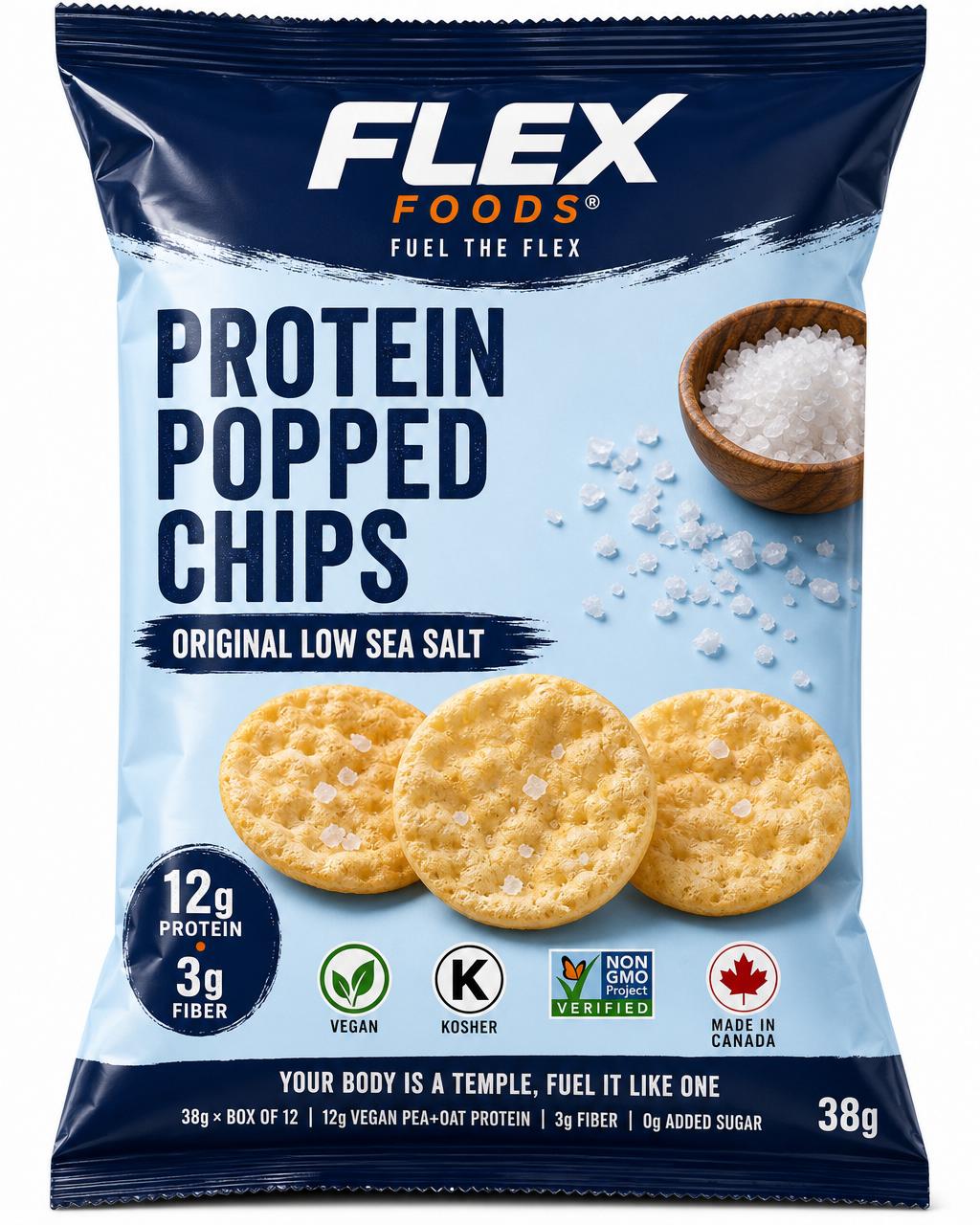
On our own product, the honest answer: the ingredient list for Protein Popped Chips is pea protein isolate, oat protein, brown rice, sunflower oil, natural seasoning, sea salt and spices — no nuts, no dairy, no soy, no egg. The only precautionary allergen statement on the bag is "may contain oats."
If your school has a strict allergen protocol, don't rely on that summary. Email hello@flexfoods.ca for current facility allergen documentation, and check it against your school's requirements. A parent managing a classmate's severe allergy deserves paperwork, not reassurance. Our full guide to reading these statements is in gluten-free and soy-free labelling.
The trade table
Here is the thing that determines whether food gets eaten: children trade, and they trade on social value rather than nutrition.
Which means a snack has to clear a specific bar — it has to be something a child is not embarrassed to open. Not necessarily the most popular item at the table. Just not the one that gets commented on.
What clears that bar, in rough order:
- Things that look like normal snacks. A savoury chip in a printed bag reads as a chip. A beige protein product in clinical packaging reads as health food, and gets left. This is unfair and it's also how it works.
- Things that come in a bag rather than a container. Openable, shareable, disposable. Containers signal "packed by a parent."
- Things with flavour opinions attached. A child who prefers one flavour over another is a child who is engaged with the food. Variety packs are genuinely useful here for exactly that reason.
What doesn't clear it: anything requiring cutlery, anything that leaks, anything with visible seeds or unfamiliar texture, and anything that has been cut up and browned since 7am.
Practical lunchbox builds
The protein-forward standard
A sandwich or wrap with a real protein filling — hummus, bean spread, plant deli slices, or whatever your household eats — plus a savoury protein snack, plus fruit, plus water. The snack is doing the afternoon work.
The bento, for kids who won't eat sandwiches
Compartments beat assembly. Roasted chickpeas, cheese or plant cheese cubes, crackers or chips, cucumber, berries. Several small things get eaten more reliably than one large thing.
The 38 g bag as a component
One bag is 150 calories, 12 g of protein and 3 g of fibre with no added sugar. For context, that's more protein than a typical children's yogurt tube and considerably less sugar. It's a component of a lunch, not a lunch.
Worth noting the sodium: 200 mg per bag, 9% of an adult daily value. For a younger child that's a larger share of their appropriate intake, so one bag in a lunch is reasonable and two savoury packaged items in the same lunch probably isn't.
Three tactics that actually change behaviour
Let them choose from a shortlist. Not "what do you want" — "which two of these four." Autonomy within constraints gets food eaten, and it's less work than negotiating from scratch.
Rotate. Appetite for a specific flavour declines with repeated exposure faster than appetite for food in general. The same snack five days a week gets rejected by week three, and parents read that as fussiness when it's a normal perceptual effect. Six flavours in rotation solves it structurally.
Check the box, don't interrogate. What comes home tells you more than what a child reports. Two weeks of noticing what returns uneaten is better data than any conversation.
The honest caveat
A packaged snack is a convenience item, and the nutritional foundation of a child's lunch should be whole food — beans, eggs, dairy or its alternatives, vegetables, fruit, whole grains. Those do more for less money and they always will.
What a well-built savoury snack does is occupy the slot where the alternative is a fruit-flavoured gummy or a bag of standard chips. Judge it against that, not against a home-cooked lunch.