Brand & Values
How to Check a Creatine Gummy Actually Contains Creatine
Creatine degrades to inert creatinine in water and acid. Here's the question to ask every brand — including us.
This is the most important post on this blog, and it's the one that could cost us a sale. We'd rather you buy a tested product from a competitor than an untested one from us.
The chemistry problem
Creatine monohydrate is remarkably stable as a dry powder. Stored sealed and cool, it holds its potency for years.
In water, it isn't. Creatine in aqueous solution undergoes intramolecular cyclisation to creatinine — a biologically inert waste product that does nothing for muscle phosphocreatine stores. Three factors accelerate that conversion:
- Water — the reaction requires it
- Acidity — lower pH speeds it up substantially
- Heat — as with most chemical reactions
Now consider what a gummy is. It contains water and glycerin. It contains citric acid — necessary for flavour and for pectin to set correctly. And it's manufactured by heating a slurry and depositing it into moulds.
All three degradation drivers are present, structurally, in the format. This isn't a manufacturing defect; it's the nature of putting creatine into a confectionery matrix.
Fuller chemistry in why creatine degrades in water.
What independent testing has found
This is not theoretical. Independent laboratory analyses of creatine gummy products available to consumers have repeatedly found substantially less creatine than declared on the label — in some reported cases, a small fraction of the stated amount, with correspondingly elevated creatinine.
Some products have tested near their label claim. Others have not. From the outside, the packaging looks identical.
The result is a category where the label number tells you what a manufacturer intended to put in, not what's in the pouch when you open it.
What a manufacturer can actually do
The problem is manageable. Several levers exist:
- Depositing temperature and dwell time. Lower and shorter means less degradation during manufacture.
- pH management. Buffering agents — sodium citrate appears in our non-medicinal ingredients — moderate acidity.
- Water activity. Lower available water slows the reaction across shelf life.
- Overage. Adding more than the label claim so that degradation across shelf life still leaves the declared amount at expiry. Standard practice in supplements — see supplement overage explained.
- Packaging. Opaque, moisture-barrier, resealable.
All of those help. None of them replaces the only thing that actually tells you what's in the product.
The question to ask
One question, and it's specific:
"Can you provide a certificate of analysis showing creatine monohydrate content in finished product, tested near the end of shelf life, with creatinine also quantified?"
Every clause is doing work.
"Finished product" — not the raw ingredient. Testing the creatine powder before it goes into the batch tells you nothing about what survives manufacturing. This is the most common substitution.
"Near the end of shelf life" — not the day it was made. Degradation continues in the pouch. A day-one result tells you about manufacturing, not about the product a customer opens in month ten.
"Creatinine also quantified" — this is the tell. If creatine is low and creatinine is high, you're looking at degradation. Some analytical methods can conflate the two if not properly specified, so quantifying both closes that gap.
"Certificate of analysis" — an actual lab document, not a marketing statement that a product is "tested for quality."
What to do with the answer
They provide it and the numbers hold up. Good. That's a brand doing the hard part.
They provide raw-material testing instead. Ask again for finished product. If it doesn't exist, that's the answer.
They cite a certification logo. Check what it certifies. Some third-party programmes verify banned-substance absence without verifying active content; others verify content. They're different tests. See third-party testing explained.
They point to an NPN. A Natural Product Number means Health Canada reviewed the product submission against a monograph — a meaningful regulatory step, and not the same as ongoing finished-product potency verification. See what an NPN means.
They don't respond, or answer vaguely. Treat that as informative.
Applying this to us
We'd be inconsistent to write all of that and then ask for an exemption.
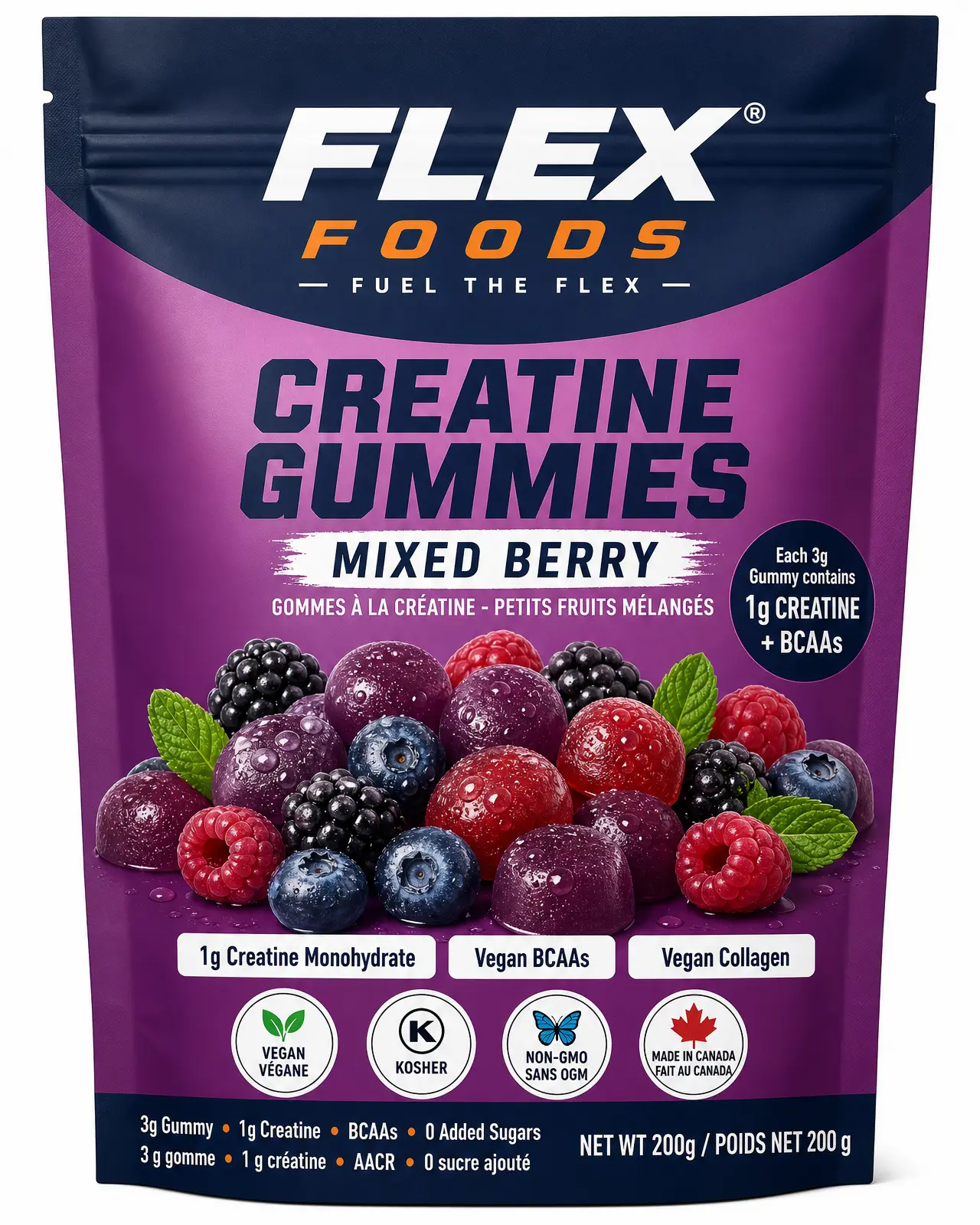
Our label declares creatine monohydrate 1 g per gummy as the medicinal ingredient, with a serving of three gummies for 3 g daily. If you want the finished-product testing data behind that number, email hello@flexfoods.ca and ask the question above, in those words.
If we can't produce it, you've learned something worth knowing before you buy — and we'd rather you find out from this page than from a lab report someone else publishes.
The alternative that sidesteps all of this
Buy monohydrate powder. It's dramatically cheaper, chemically stable, and the potency question barely arises.
The case for a gummy is adherence — a format you'll actually take daily for months, because creatine only works through sustained saturation. That's a real argument, made in gummies vs powder.
But it's only an argument if the creatine is in there. Ask first.