
Fuel Science
Creatine Gummies vs Powder: The Honest Comparison
Powder is cheaper and more stable. Gummies win on one variable that turns out to matter a lot.
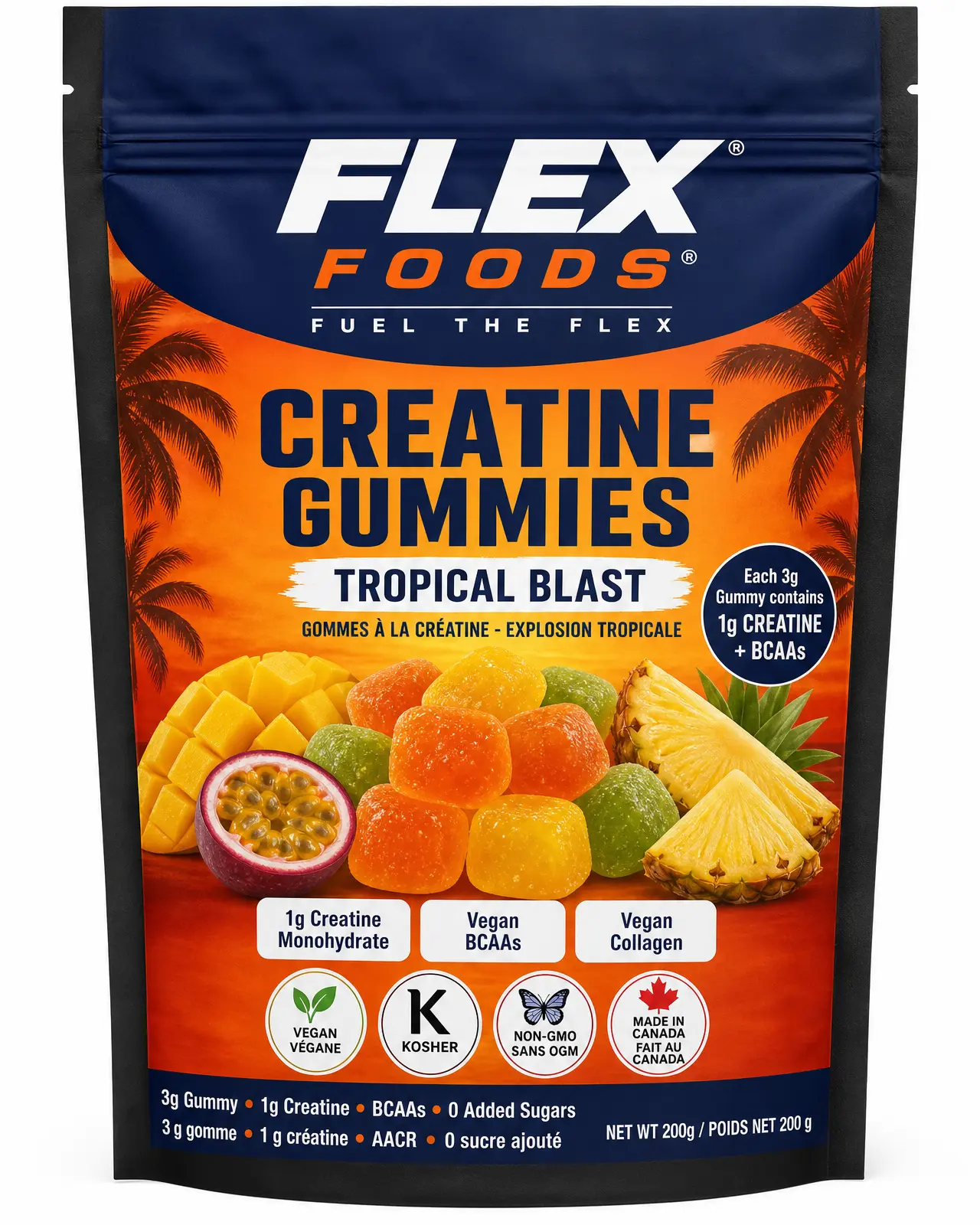
We sell gummies, so read this with appropriate suspicion. It's still worth doing properly, because there are two places where powder is clearly better and one where gummies are — and the marketing in this category rarely says so.
Cost, where powder wins outright
Not close. Bulk creatine monohydrate powder is one of the cheapest supplements available, typically working out to a few cents per gram. A 1 kg tub at Canadian retail generally lands somewhere in the range where a 5 g daily dose costs well under a dollar a month.
Any gummy will cost multiples of that. You're paying for confectionery manufacturing, individual dosing, flavour, packaging and a considerably lower creatine density per gram of product.
If cost per gram of creatine is your criterion, buy powder. We're not going to construct an argument against arithmetic. Full comparison in creatine cost per gram.
Stability, where powder also wins
This is the more important one and the industry doesn't like discussing it.
Creatine monohydrate is stable as a dry powder — very stable, for years. In aqueous conditions it converts to creatinine, a biologically inert breakdown product. That conversion is accelerated by three things: water, acidity, and heat.
A gummy contains water and glycerin. It contains citric acid. It is manufactured by heating a slurry and depositing it into moulds. All three degradation drivers are present, by necessity.
This is not a hypothetical concern. Independent testing of creatine gummy products has repeatedly found substantially less creatine than labelled, in some cases dramatically less. It is the central credibility problem in this product category.
What a manufacturer can do about it: control depositing temperature and dwell time, buffer the pH, formulate for low water activity, add overage to cover degradation across shelf life, and — the part that actually matters — test finished product at multiple points during shelf life and publish the results.
If you're buying any creatine gummy, ours included, ask for that testing data. If a brand can't produce a certificate of analysis showing creatine content in finished product near end of shelf life, you don't know what you're buying. We go through how to ask in how to check a creatine gummy actually contains creatine.
Where gummies win: adherence
Here's the argument for the format, and it's a real one.
Creatine works through saturation. Muscle stores build over days to weeks of consistent intake and wash out over four to six weeks when you stop. Which means the supplement only works if you actually take it, most days, for months.
Powder requires a container, water, a scoop and a rinse. It's a small friction, applied daily, indefinitely. And small daily frictions are exactly what determines whether a habit survives past month three.
Adherence is not a soft consideration in supplement outcomes — it's arguably the main one. A product with 100% of its label claim that sits in a cupboard delivers nothing. A format you'll actually use every day for a year delivers the full effect.
That's the entire case for a chewable format, and we think it's a good one. It doesn't rescue a gummy that's degraded, which is why the two arguments have to be held together.
The dose-per-unit problem
An honest limitation of the format.
Our gummies carry 1 g of creatine per 3 g gummy. The label serving is three gummies — 3 g of creatine daily, at the low end of the commonly cited 3–5 g maintenance range.
Getting to 5 g means five gummies, which is 15 g of gummy and 15 g of sugar alcohols. And a standard loading protocol — 20 g daily for five to seven days — would mean twenty gummies a day and around 60 g of maltitol. That is not a realistic or comfortable proposition, and we'd rather say so than let someone work it out the hard way.
Practically: gummies suit maintenance dosing, not loading. Detail in do you need to load creatine and the maltitol post.
Side by side
| Powder | Gummies | |
|---|---|---|
| Cost per gram of creatine | Very low | Substantially higher |
| Stability | Excellent, dry | Requires formulation control and testing |
| Loading practical? | Yes | No |
| Needs water and a scoop | Yes | No |
| Travel and work friendly | Awkward | Easy |
| Taste | Chalky, gritty | Fruit |
| Dose precision | Exact by scale | Fixed 1 g increments |
| Adherence over months | Lower for many | Higher for many |
The honest recommendation
If you're disciplined, cost-conscious, want to load, or want the highest confidence in dose accuracy: buy monohydrate powder. It's the reference standard for good reason.
If you've bought powder before and it's still three-quarters full six months later, a format you'll actually take daily is worth more than a cheaper one you won't. That's the trade, stated plainly.
Either way, ask whoever you buy from for third-party finished-product testing. That question does more for you than choosing a format.