Brand & Values
What Health Canada Lets a Creatine Product Claim
The monograph specifies what a creatine product may say. Most of what you see online falls outside it.
Supplement claims in Canada are more constrained than most people realise, and creatine has a specific set of permitted statements. Knowing the boundary tells you a lot about which brands are operating within the rules.
How the system works
Creatine products are regulated as Natural Health Products under the Natural Health Products Regulations. A product licence and an NPN are required before sale.
Health Canada publishes monographs for well-characterised ingredients — pre-assessed documents specifying acceptable doses, durations, populations, permitted claim wording and required risk statements.
Creatine monohydrate has a monograph. A product formulated within it can use a streamlined application; a product making claims outside it needs a full submission with its own evidence package.
This is why creatine products across different brands carry strikingly similar wording — they're drawing on the same pre-assessed document. See what an NPN means.
What sits inside the monograph
Broadly, the permitted claim territory for creatine concerns muscle and performance outcomes in healthy adults engaged in resistance training — improvements in strength and lean muscle mass when used alongside a training regimen.
Note the components built into that framing:
- Healthy adults. The monograph is written for adults, which is why our product is intended for adults. See should teenagers take creatine.
- In conjunction with resistance training. The claim isn't for creatine alone — it reflects that the evidence base is built on supplementation alongside training.
- Specified dose ranges for maintenance and, where applicable, loading.
- Required risk statements, typically covering consultation with a healthcare practitioner for pregnancy, breastfeeding and kidney conditions.
We're describing the shape of the monograph rather than quoting it. If you want the exact authorised wording for a specific product, Health Canada's Licensed Natural Health Products Database lets you look it up by NPN.
What sits outside it
This is the more useful list, because it's where a lot of online marketing lives.
Cognitive claims. Memory, focus, mental performance. There's a genuine research literature here, generally using doses above a maintenance serving with small effect sizes concentrated in older adults and vegetarians — and it isn't part of the standard creatine monograph. See creatine and brain energy.
Sleep claims. An early research area using substantially higher doses. Not permitted territory. See creatine and sleep.
Mood and mental health claims. A small adjunct literature exists in depression research. Creatine is not a treatment for depression and marketing it that way would be well outside both the evidence and the rules. See creatine and mood research.
Fat loss claims. No mechanism, no evidence.
Bone density claims. Promising when combined with resistance training in older adults, unsettled, not permitted. See creatine and bone density.
Anti-ageing, longevity, immune or metabolic disease claims. Well outside.
Why the rules look restrictive
It can seem excessive that a company can't mention research it can cite. Two things are worth holding together.
The framework is deliberately conservative because supplement claims influence purchasing by people who mostly can't evaluate the evidence themselves. Setting the bar at pre-assessed evidence rather than at "a study exists" is a defensible position.
It also means a Canadian label understates what's known in some areas. That's a genuine cost of the approach, and it's part of why a blog like this exists — we can describe research context that a label can't, provided we're clear that no claim is being made.
How to use this as a shopper
Three checks:
Is there an NPN? Required on any NHP sold in Canada, and verifiable in Health Canada's public database.
Do the marketing claims match the authorised ones? A product page promising focus, mood, fat loss or anti-ageing from creatine has drifted beyond what was licensed. That's a signal about the brand's general reliability, not just about that claim.
Is the dose disclosed? Canadian NHP rules require quantity per dosage unit for medicinal ingredients — a real advantage over markets where proprietary blends hide it. See proprietary blends.
What we claim
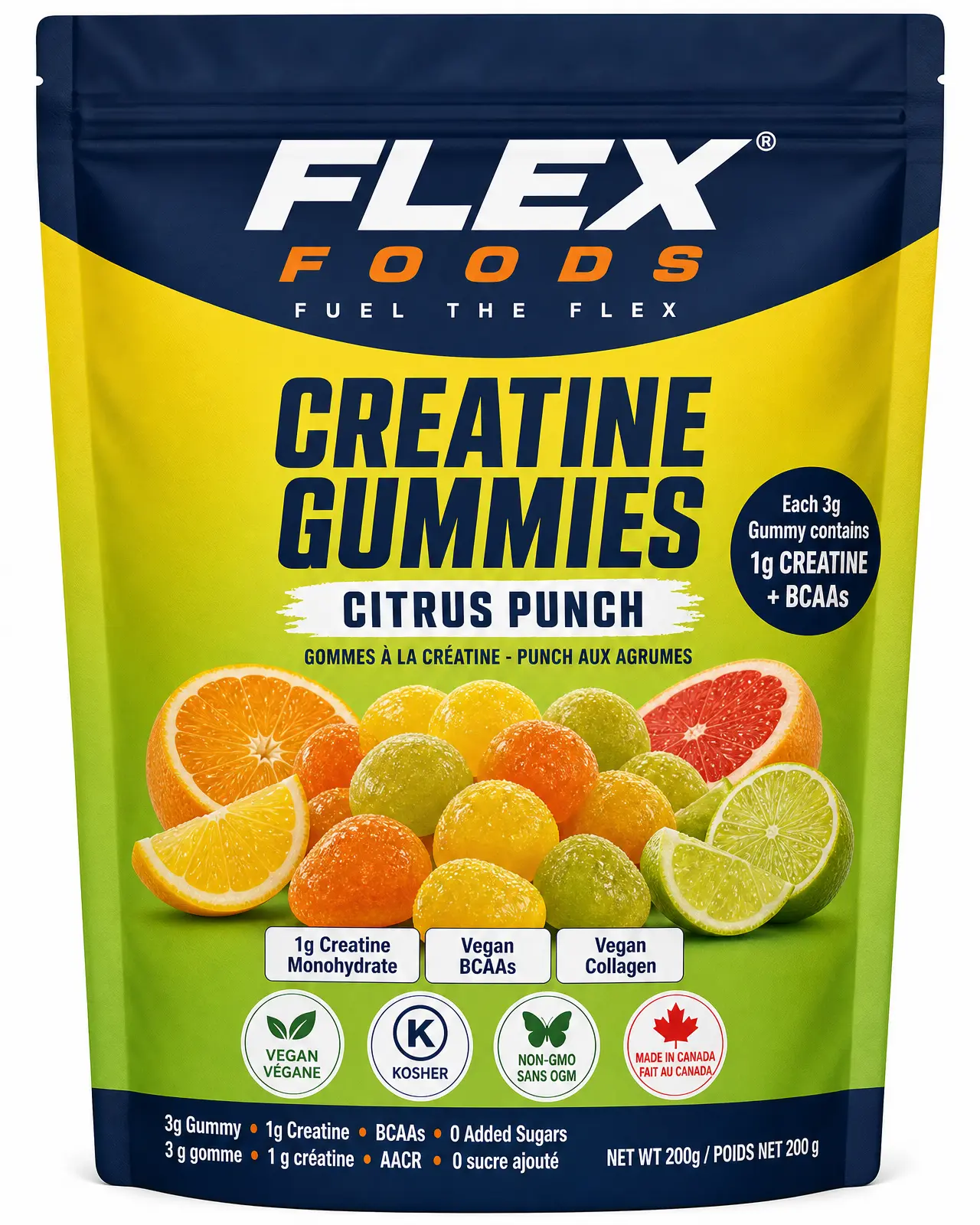
Our packaging states the quantity — 1 g of creatine monohydrate per 3 g gummy — and the directions, three gummies daily.
On this blog we describe research in areas the monograph doesn't cover, and in each case we say plainly that no claim is being made and that the study doses exceeded our serving. That distinction between describing evidence and making a claim is the line we're working to.
If you think we've crossed it anywhere, tell us: hello@flexfoods.ca.
General information about a natural health product, not medical advice.