Nutrition 101
Calories in a Gummy: Where 45 Comes From
Forty-five calories per serving, and almost none of them come from the creatine. A line-by-line read.
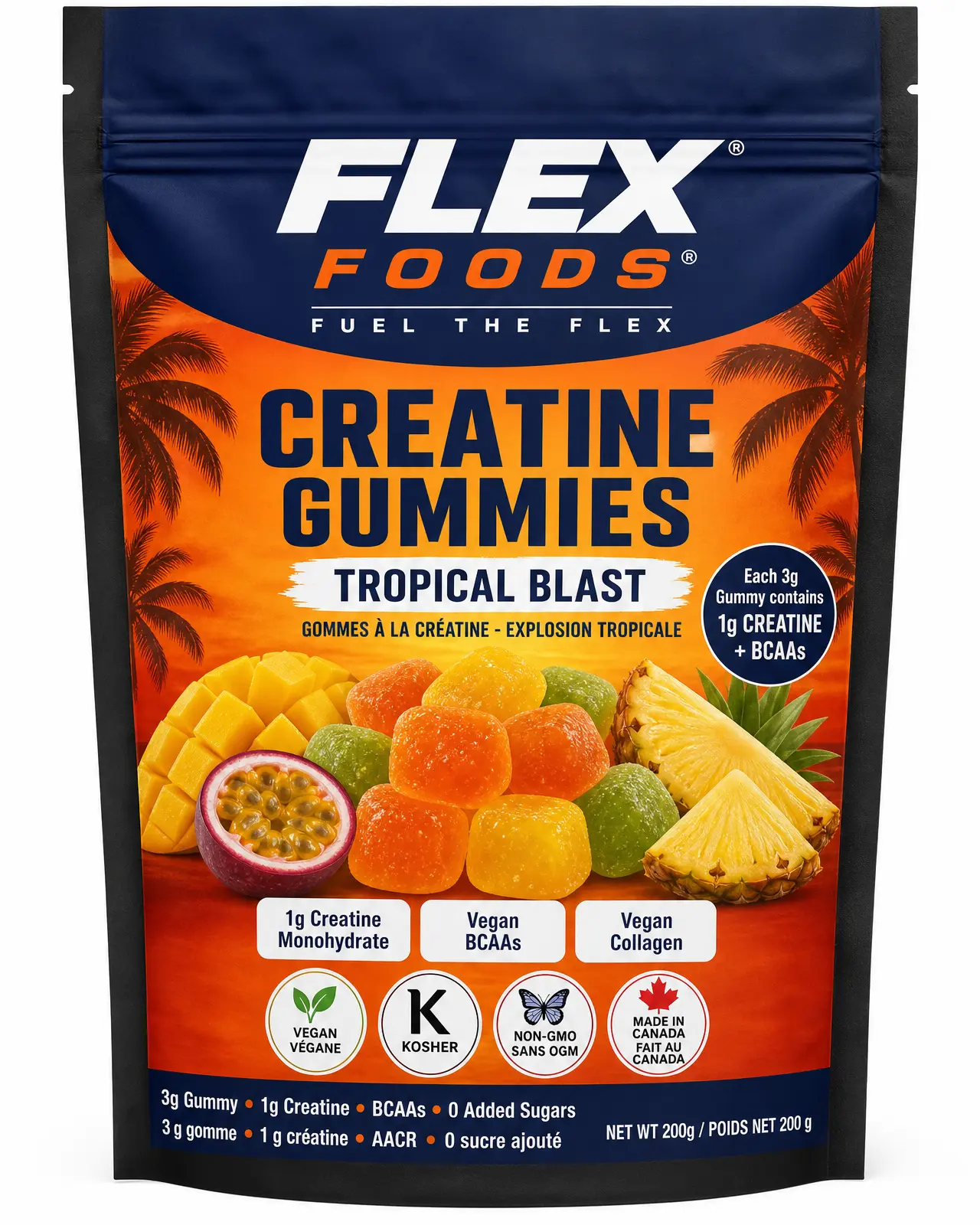
A supplement with a calorie count seems slightly odd, and it's a reasonable thing to want explained — particularly if you're tracking intake.
Here's the panel and where the numbers come from.
The panel
| Per 3 gummies (9 g) | |
|---|---|
| Calories | 45 |
| Fat | 0 g |
| Sodium | 15 mg (1%) |
| Carbohydrate | 11 g |
| Fibre | 0 g |
| Sugars | 0 g |
| Sugar alcohols | 9 g |
| Protein | 0 g |
| Potassium / Calcium / Iron | 0 |
Twenty-two servings per 200 g pouch.
Where the calories come from
Almost entirely from the bulk sweetener.
Sugar alcohols aren't calorie-free. They're incompletely absorbed, so they deliver fewer calories than sugar — maltitol is commonly assigned around 2.1 calories per gram against sugar's 4 — but they aren't zero.
Nine grams of sugar alcohols accounts for roughly 19 calories on that basis. The remainder comes from the other carbohydrate components in the matrix, including glycerin, which carries around 4.3 calories per gram and functions as a humectant rather than a sweetener.
Exact assignment depends on how individual components are calculated, so treat that as an explanation of the sources rather than a precise reconstruction. The declared total is 45.
What contributes nothing
The creatine. Three grams of creatine monohydrate contributes essentially nothing to the calorie count. It isn't fat, isn't carbohydrate, and isn't protein — which is also why the panel reads 0 g protein.
That's worth sitting with: the active ingredient is not where the calories are. You're consuming 45 calories to deliver a 3 g dose of a calorie-free compound. The calories are the delivery vehicle.
Creatine monohydrate powder delivers the same 3 g with zero calories. That's a straightforward advantage of powder, and a fair thing to weigh. See gummies vs powder.
Reading the carbohydrate block
Three lines that need reading together, because their relationship confuses people.
Total carbohydrate (11 g) is the umbrella figure. Fibre, sugars and sugar alcohols are components within it, not additions to it.
Sugars 0 g is accurate. Sugar alcohols are not classified as sugars for labelling purposes, so a maltitol-sweetened product legitimately declares zero sugars.
Sugar alcohols 9 g is the line that actually tells you what's sweetening the product — and the one people skip.
Important: 0 g sugars does not mean no glycemic effect. Maltitol is partially digested to glucose and has a glycemic index commonly cited between roughly 35 and 52. See zero added sugar vs sugar alcohols.
Does 45 calories matter?
Context, for a few common situations.
General use. Forty-five calories daily is roughly 1–2% of a typical adult's intake. Not a meaningful line item.
Weight loss. Still minor. If you track closely, count it — and count the 11 g of carbohydrate, which is the more relevant figure for anyone on a low-carbohydrate approach. See creatine in a cut.
Taking more than three gummies. This is where it scales. Five gummies for a 5 g creatine dose means roughly 75 calories, 18 g of carbohydrate and 15 g of sugar alcohols. The last figure matters more than the calories — sugar alcohols commonly produce digestive symptoms above roughly 20–30 g daily. See the maltitol post.
Low-carbohydrate or ketogenic diets. Eleven grams of carbohydrate is significant against a strict daily target. Powder is the obvious alternative — zero carbohydrate, zero calories.
The two zeroes worth noticing
Protein 0 g. Creatine is an amino acid derivative, not a protein. A creatine product doesn't contribute to protein intake and doesn't substitute for it. It's also a useful cross-check on any supplement label — a product declaring 0 g protein cannot contain a meaningful amount of any amino acid or protein-based ingredient.
Fibre 0 g. There's no fibre source in the formulation, and the panel declares it accurately.
The summary
Forty-five calories, almost all from the sweetener that makes the gummy a gummy. The creatine itself contributes none of them.
General information about a natural health product, not medical advice.