
Brand & Values
The Case for 1 g Per Gummy
Dose per unit determines how many you chew. Here's why we landed on one gram, and what it costs you.
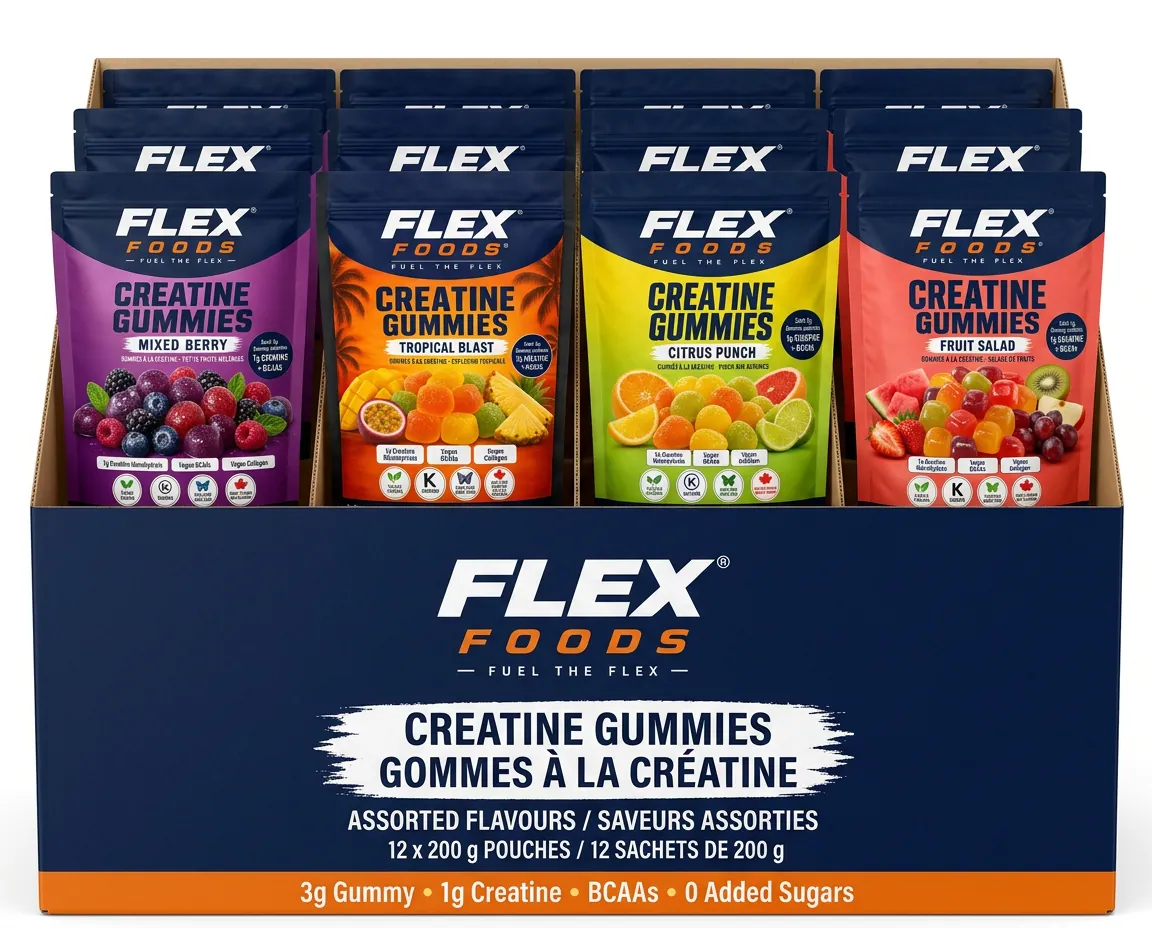
A 4 g gummy carrying 1 g of creatine (alongside 0.5 g of vegan BCAAs) is 25% creatine by weight. That's high for a confectionery matrix, and it's the outcome of a specific set of constraints pulling against each other.
The four constraints
1. Texture degrades as loading increases
Creatine monohydrate is a crystalline powder. Suspending it in a pectin gel is fine at low concentrations and increasingly problematic as you add more.
Past a certain loading the gummy becomes gritty, the gel network is disrupted, and the set weakens. There's a ceiling on how much you can put in something that still eats like a gummy.
2. Flavour masking gets harder
Creatine has a distinct character — chalky, faintly bitter, slightly alkaline. In a sweetened gel matrix that's maskable at moderate loading and progressively less so as concentration rises.
Without sugar, which is an excellent masking agent, the margin is narrower still. See flavour development without sugar.
3. Gummy size has a practical limit
You could load more creatine per gummy by making the gummy bigger. But a gummy has to be a comfortable single bite, and past roughly 4–5 g people start finding them unpleasant to chew.
4. Sugar alcohols scale with the matrix
The constraint people don't anticipate.
Every gram of gummy carries its share of maltitol. Because maltitol is the main sweetener, sugar alcohols scale with how many gummies you take — check the nutrition panel on your pouch. At our recommended daily serving of 3–4 gummies, you stay comfortably under the threshold where most people experience digestive symptoms, which is commonly cited above 20–30 g daily.
Pushing to twenty gummies for a high-dose loading protocol would deliver a heavy polyol load that could cause significant distress. See the maltitol post.
So the polyol load caps the practical serving size, which caps the creatine dose, unless you raise loading per gummy — which runs into constraints one and two.
What the alternatives would have meant
| Design | Gummies for 3 g | Trade-off |
|---|---|---|
| 0.5 g per gummy | 6 | Better texture, twice the sugar alcohols |
| 1 g per gummy (ours) | 3 | Manageable sugar alcohol load, workable texture |
| 1.5 g per gummy | 2 | Grittier, harder to mask, weaker set |
| 2 g per gummy | 1.5 | Likely unpalatable |
One gram per 4 g gummy is where texture, flavour, bite size and polyol load intersect acceptably.
What it costs you: 3 g is the bottom of the range
The honest consequence, stated plainly.
The commonly cited maintenance range for creatine is 3–5 g daily. At the lower end of our recommended 3–4 gummy serving, three gummies delivers 3 g — the bottom of it.
That will saturate muscle stores and hold them. It will take longer than 5 g would — roughly four weeks rather than three — and for larger individuals it's less generous than ideal.
A weight-adjusted maintenance figure commonly cited is around 0.03 g per kilogram. That comfortably covers people up to around 85 kg with margin, and sits low for people above roughly 90–100 kg. See creatine dose by bodyweight.
If you're larger or training heavily, stay within the 3–4 gummy label serving, and anyone wanting a higher creatine dose should top up with plain creatine monohydrate powder or speak with a health professional. Plain powder is cheaper and adds no polyols. Inelegant and entirely sensible.
Why we didn't just claim a 5 g serving
We could have chased a 5 g serving claim — though a 5 g dose from gummies would take 20 g of gummy, which is above our label serving — and put "5 g creatine per serving" on the front. It would have looked better against competitors.
Two reasons we didn't:
Recommending that many sugar alcohols daily as a default is a lot. Maltitol is the main sweetener, so polyols scale with every gummy; pushing the default serving that high approaches the range where a meaningful share of people get digestive symptoms, and a product that makes you uncomfortable is a product you'll stop taking.
A pouch would last 12 days instead of 15–20 at that intake. Which flatters the per-serving number and worsens the cost per gram of creatine — the figure that actually matters. See creatine cost per gram.
Three to four gummies (3–4 g) is the honest default range. Stay within the 3–4 gummy label serving, and top up with plain creatine monohydrate powder if your bodyweight warrants a higher dose.
The transparent version of the number
- 1 g creatine monohydrate (+ 0.5 g vegan BCAAs) per 4 g gummy
- 3–4 g creatine per daily serving of 3–4 gummies
- 0 g sugars; maltitol is the main sweetener, so sugar alcohols scale with how many gummies you take — check the nutrition panel on your pouch
- 60 g creatine per 240 g pouch
- 15–20 days per pouch
Every one of those is on the label or derivable from it. Run the arithmetic on any competitor and compare.
General information about a natural health product, not medical advice.