Brand & Values
Flavour Development Without Sugar
Creatine has a flavour. Covering it without sugar, while keeping acidity low enough to protect it, is the hard part.
Flavour development for a creatine gummy involves a constraint most confectionery doesn't have: the thing you're masking is also the thing you're trying not to destroy, and the usual masking tools destroy it.
What creatine tastes like
Creatine monohydrate has a distinct character — chalky, faintly bitter, slightly alkaline, with a lingering quality that's hard to clear.
Anyone who's mixed monohydrate powder into water knows it. It isn't strong, and it isn't pleasant, and it persists.
At 33% of the gummy by weight, that's a substantial amount of character to cover.
The tool we don't have
Sugar is the most effective flavour masking agent in confectionery. It suppresses bitterness directly, provides bulk that dilutes off-notes, and creates a sweet reference the palate reads first.
Removing it means replacing it with a combination of things that individually do less.
Maltitol provides bulk and most of the sweetness, but it's slightly less sweet than sucrose and doesn't suppress bitterness as effectively.
Stevia adds sweetness at tiny doses and no bulk. It also brings its own faint bitter, liquorice-adjacent note at higher concentrations — meaning you can't simply add more to compensate. See stevia, anthocyanins and natural colour.
The acid problem
Here's the constraint specific to creatine, and it's the awkward one.
Acidity is the primary tool for bright fruit flavour. It's also what makes high-methoxyl pectin set. And it is the strongest accelerant of creatine's conversion to inert creatinine.
So every decision to make the flavour brighter is a decision to lose more creatine over shelf life. See why creatine degrades in water.
Two things mitigate it. Low-methoxyl pectin sets via calcium rather than acid, allowing a higher pH than a conventional gummy would need. And sodium citrate buffers the system, moderating pH swings.
Neither eliminates the tension. A creatine gummy will always be less acid-forward than the same fruit flavour in a vitamin gummy, and that's a real limit on how sharp the flavour can be.
Why fruit profiles
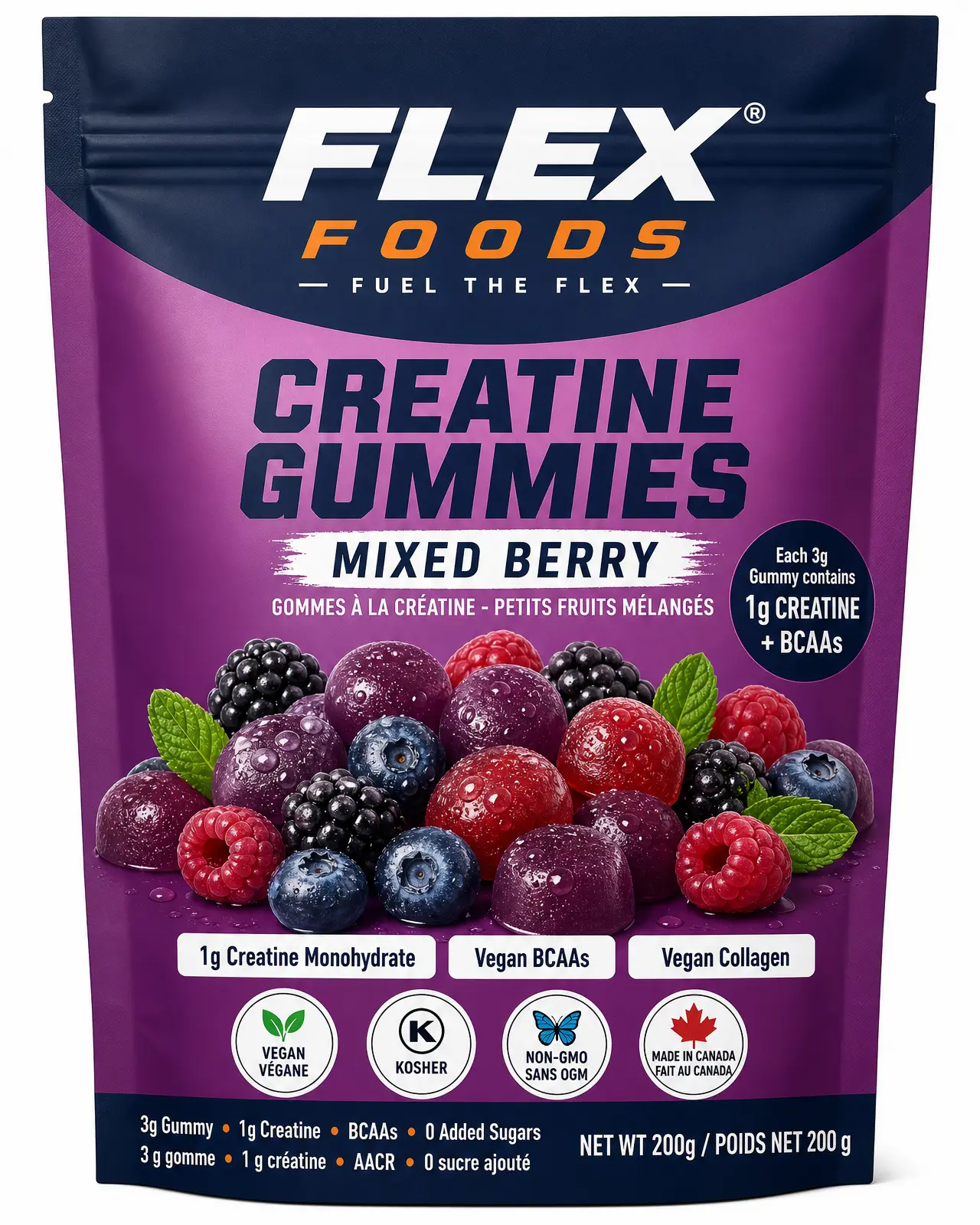
The four flavours — Mixed Berry, Tropical Blast, Citrus Punch, Fruit Salad — are all fruit, and that's deliberate rather than default.
Fruit flavours are aromatically complex. Complexity helps: a flavour with many aromatic components occupies more perceptual space than a simple one, leaving less room to notice an off-note underneath.
Dark fruits mask better than light ones. Berry profiles — with their deeper, jammier notes — cover a chalky bitter character more effectively than a delicate flavour like pear or melon would. That's part of why Mixed Berry exists.
Citrus brings aromatic brightness without requiring maximum acidity. Peel oils read as "citrus" through aroma rather than through sourness, which is useful when you're constrained on acid. Retronasal aroma contributes more to what we call flavour than the tongue does.
Tropical profiles carry sweetness aromatically. Mango, pineapple and passionfruit have ester compounds perceived as sweet through smell, before taste is involved. That's genuinely useful when sweetness is limited.
What doesn't work
Three directions that are difficult in this specific product.
Sour profiles. The obvious commercial move for a gummy, and the worst one here. Sour requires high acid, both in the matrix and as a surface coating, and both accelerate degradation. See why our gummies aren't sugar-coated.
Delicate flavours. Cream, vanilla, floral notes. Not enough aromatic mass to cover the base.
Cola and confectionery profiles. Heavily dependent on a specific sugar-acid balance that's difficult to reproduce without sugar.
The colour constraint
A related complication. Anthocyanins — the plant pigments providing colour — shift hue with pH: red in acid, purple toward neutral, blue in alkaline conditions.
So adjusting pH to protect creatine also moves the colour. A formulation decision made for stability shows up visually, which means colour and stability have to be developed together rather than sequentially.
The honest assessment
A creatine gummy will not taste like a confectionery gummy. It's less sweet, less acid-forward, and carries a base note the flavour is working against.
What it should be is good enough that you'll eat three every day for a year — which is the entire point of the format. Adherence is the argument for a gummy, and flavour is what delivers adherence. See why we made a gummy.
If it doesn't taste good enough for that, the format has failed at its one job.
General information about a natural health product, not medical advice.