
Nutrition 101
Popped Chips Nutrition Facts, Explained Line by Line
A guided tour of one nutrition panel, line by line — including the footnote most people never read.
The Nutrition Facts table is the most useful thing on a food package and the least read. It's also the only part that's legally standardised, which makes it the only part you can compare across brands without doing translation work.
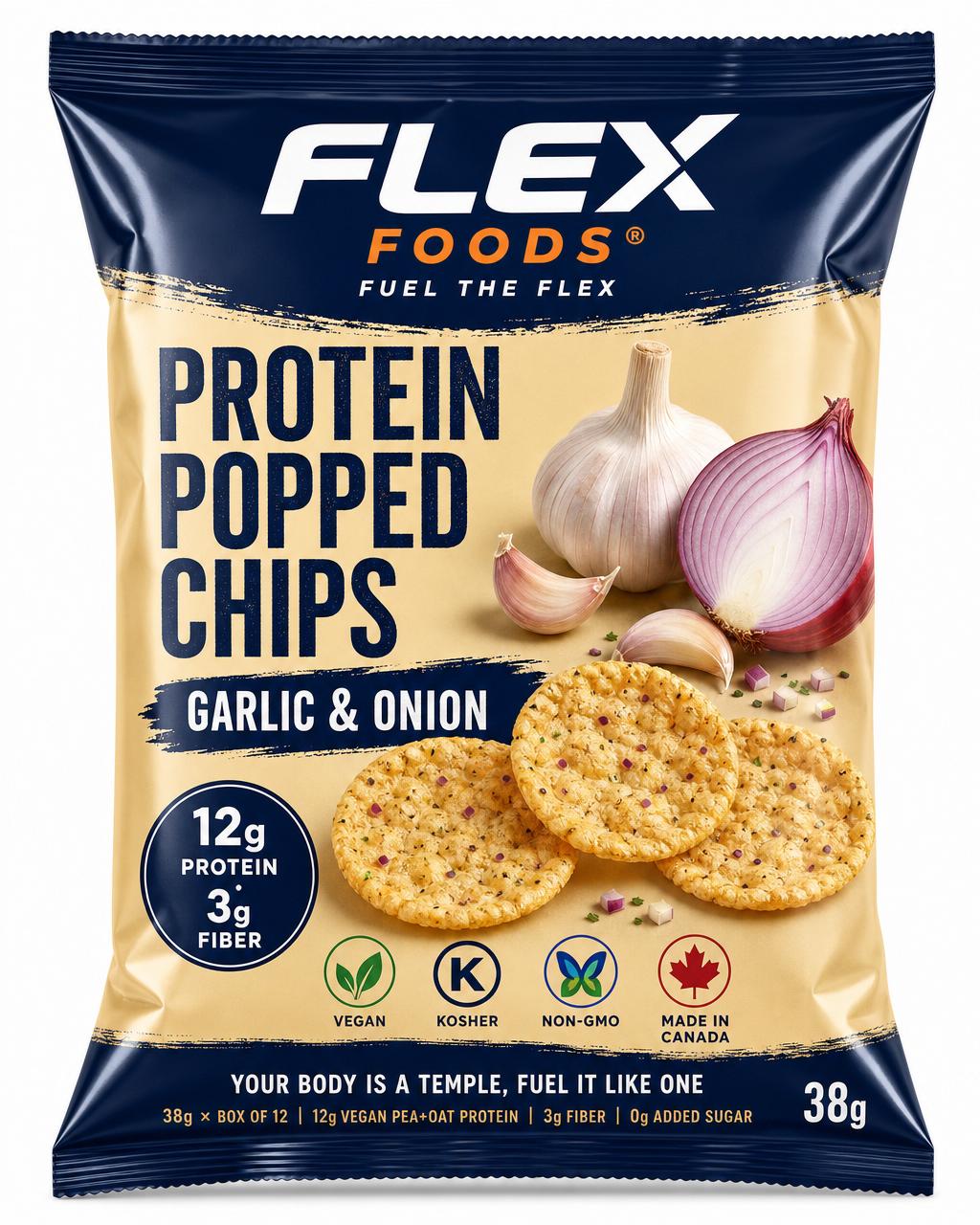
So let's walk one all the way down. This is the panel on the back of a 38 g bag of Protein Popped Chips, and the reasoning applies to anything in your cupboard.
The line above everything else: serving size
Every number below it is meaningless without this line. Ours reads Per 38 g bag, which is convenient — the serving is the whole package, so there's no arithmetic.
Be suspicious when it isn't. Canada sets Reference Amounts to standardise serving sizes within a category, and for snack chips that reference amount is 50 g. But a manufacturer can declare a serving based on the actual package if it's a single-serve item, and larger bags frequently declare a serving that's a fraction of what anyone eats. A 200 g bag declaring 28 g servings is technically compliant and practically misleading.
Check this first, every time. If two products look different, confirm they're being measured the same way before you conclude anything.
Calories: 150
One number, no percentage. Health Canada deliberately doesn't assign a % Daily Value to calories, because a daily calorie target is individual — it depends on your size, activity and goals in a way sodium doesn't.
150 calories is a genuine snack rather than a mini-meal. For comparison: a 40 g serving of fried potato chips is roughly 220, a typical protein bar 200–250, a medium apple about 95.
Fat: 4 g (5%), Saturated 0.5 g + Trans 0 g (3%)
Note the format. Canadian panels group saturated and trans fat into a single % Daily Value, because both are associated with raised LDL cholesterol and the recommendation for both is "as low as possible." Total fat gets its own line based on a 75 g daily reference.
Four grams in a savoury snack is low, and it's low because of the process rather than restraint — popped chips aren't submerged in oil, so the only fat present is a thin sunflower oil coating that helps seasoning stick. We go through the mechanics in what popping actually does to a chip.
Trans fat at 0 g is unremarkable now. Canada banned partially hydrogenated oils in 2018, so anything on a Canadian shelf should read 0. If it doesn't, that's worth a second look.
Sodium: 200 mg (9%)
The % DV is calculated against 2,300 mg, Health Canada's daily value. Nine percent per serving is moderate — noticeable but not high.
The honest caveat: savoury snacking compounds. Two bags is 400 mg, or 18%, and if the rest of your day includes bread, cheese, soup or anything from a restaurant, you're a lot closer to the ceiling than that one panel suggests. Average Canadian sodium intake runs well above the daily value already. More on managing that in low-sodium snacking.
Carbohydrate: 16 g (6%), Fibre 3 g (11%), Sugars 0 g (0%)
Three lines that need reading together.
Total carbohydrate includes fibre and sugars — they're not additional. So the actual digestible starch here is around 13 g, mostly from the brown rice that gives the chip its structure.
The fibre line at 3 g, 11% of the daily value, is the one worth noticing. Most protein snacks come in under 1 g because protein isolates are refined to strip out everything that isn't protein. Whole brown rice keeps its bran, and the bran is where the fibre lives. Why it matters: the 3 g fibre detail.
Sugars at 0 g means both naturally occurring and added sugars round to zero. On newer Canadian panels you'll also see an indented "Includes X g Added Sugars" line, which is the more informative of the two — that's the sugar a formulator chose to put in.
Protein: 12 g (24%)
Here's a quirk. Canadian panels historically didn't require a % DV for protein, because the daily value depends on protein quality, not just quantity, and quality varies by source. Where you do see a percentage, it's calculated against a 50 g reference.
The number to actually use is protein per 100 calories: 12 ÷ 150 × 100 = 8.0 g. That normalises across serving sizes and tells you whether protein is the point of the food or a garnish. Under 4 is a carbohydrate snack. Over 6 is protein-dominant.
The footnote nobody reads
At the bottom of our panel: 5% or less is a little, 15% or more is a lot.
This is Health Canada's interpretive aid and it's genuinely the most useful sentence in the table. It converts abstract percentages into a judgement. Applied here: fat is a little (5%), sodium is in between (9%), fibre is approaching a lot (11%).
Use it in the aisle. You don't need to remember daily values for eleven nutrients — you need to know that 15% is a lot, and to decide whether "a lot" is what you want for that particular nutrient.
What the panel can't tell you
Three things, so you don't over-trust it.
Protein quality. Twelve grams of pea-and-oat protein and twelve grams of whey are not nutritionally identical, and the panel treats them the same. Amino acid profile lives in the ingredient list, not the table.
Ingredient quality. Two products with identical panels can be built from seven ingredients or twenty-seven. The panel is blind to that.
Whether you'll enjoy it. Not a joke — adherence beats optimisation over any real timeframe, and a snack you don't like is a snack you'll stop buying.
Read the panel, then read the ingredient list, then buy one bag before you buy a case.