Nutrition 101
Low-Sodium Snacking Without Losing Flavour
Savoury snacking is where sodium accumulates invisibly. Here's the honest accounting, ours included.
Sodium is the nutrient most people underestimate most badly, and savoury snacks are a big part of why. Nobody accounts for the salt in a bag of chips, which is exactly what makes it a good hiding place.
We make savoury snacks. Here's the accounting, including where our own numbers sit and where they don't qualify for the claim you might expect.
The Canadian numbers
Health Canada's daily value for sodium is 2,300 mg. Actual average intake among Canadian adults runs meaningfully above that — most national survey estimates land in the 2,700–3,000 mg range, and higher for adult men.
The important detail: the majority of that sodium doesn't come from the salt shaker. It comes from processed and prepared foods, where it's already in the product before you touch it. Bread, deli meat, cheese, soup, sauces, restaurant meals and snacks. You can salt your own cooking generously and still sit under the daily value if the rest of your day is built from whole ingredients.
What sodium claims legally mean
Worth knowing, because the words are specific:
- Sodium-free — less than 5 mg per reference amount
- Low in sodium — 140 mg or less per reference amount and per serving
- Reduced in sodium — at least 25% less than a comparable reference product
- No added salt / unsalted — no salt added during processing, and the comparable product normally contains added salt
Note that "low in sodium" is a hard threshold, not a comparison. For snack chips the reference amount is 50 g, so the ceiling is 140 mg per 50 g.
Where our chips actually sit
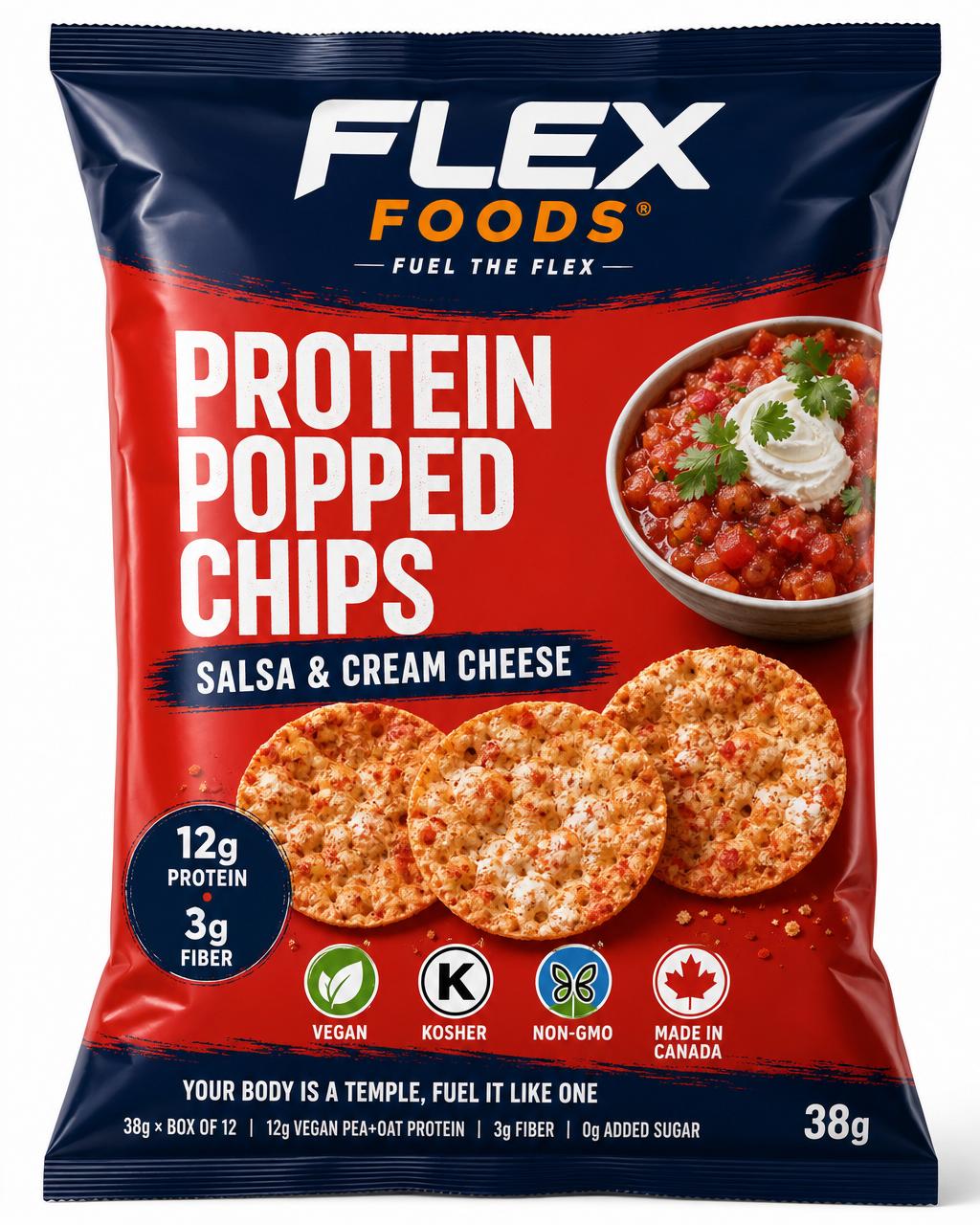
Straight numbers. A 38 g bag of Protein Popped Chips contains 200 mg of sodium, 9% of the daily value. Scaled to the 50 g reference amount that's about 263 mg, and scaled to 100 g it's roughly 525 mg.
So: we do not qualify as "low in sodium," and we don't make that claim. Nine percent per serving is moderate. It's noticeably better than a lot of the protein-snack shelf, where 800–900 mg per 100 g is common — protein-based chips often need aggressive seasoning to compensate for a less indulgent base. It's not a health food.
Being clear about that is more useful to you than a reassuring paragraph. If you're managing blood pressure and your clinician has given you a sodium target, budget our chips as roughly 200 mg and decide accordingly.
How you get flavour without more salt
This is the formulation side, and it's the same toolkit you can use in your own cooking.
Acid
Acidity and salt both cut through fat and both create a sense of brightness and completion. Lime, lemon, vinegar and tomato all let you dial salt down without the food tasting flat. California Limón leans on this hardest of our six.
Umami
Glutamates create savoury depth and mouth-filling body — the quality you'd otherwise chase with more salt. Tomato solids, roasted alliums, mushrooms and yeast extract all supply it naturally. Interestingly, umami compounds and sodium have a documented synergy: a modest amount of glutamate makes a lower salt level taste more strongly savoury than it would alone.
Aromatic complexity
Salt is a shortcut to "finished." Genuine spice complexity gets you there differently — multiple aromatic compounds arriving at different points as you chew. Our Tikka Masala works this way: cumin and coriander first, fenugreek and cardamom in the middle, a slow chili finish. That staggered arrival is what makes it read as complete. More on this in building bold flavour with 0 g added sugar.
Topical rather than internal salting
A technical trick worth knowing. Salt applied to the surface of a food hits your taste receptors immediately and at full concentration, so it reads as saltier than the same quantity dissolved throughout. Surface seasoning on a chip is more efficient per milligram than salted dough.
Budgeting sodium across a day
If savoury snacking is part of your routine, three practical moves.
Compare per 100 g, not per serving. Serving sizes aren't standardised between brands, and a small declared serving flatters the sodium line. Per 100 g is the only fair comparison.
Pick your battles by volume. Bread, deli meat, cheese and restaurant food are where the big sodium lives, because you eat a lot of them. A 200 mg snack is a rounding error next to a 1,200 mg restaurant entrée. Optimise the large contributors first.
Get potassium alongside. Dietary patterns higher in potassium are associated with better blood pressure outcomes, and most Canadians fall short of the recommended intake. Beans, potatoes, leafy greens, bananas and tomatoes. This isn't a licence to ignore sodium — it's the other half of the same equation.
And if you have hypertension, kidney disease or a clinician-set sodium target, follow that target rather than any general guidance in a blog post. This is genuinely a case where individual advice beats population advice.