
On The Go
Desk Drawer Audit: Replacing the Snacks That Aren't Working
A ten-minute audit of what you actually keep within arm's reach, and a decision rule for what replaces it.
Most people can describe their diet in general terms and have no idea what's in their desk drawer. Which is odd, because the drawer is where a meaningful share of weekday calories actually comes from — and unlike meals, nobody plans it.
This is a ten-minute audit with a decision rule at the end. Do it now, with the drawer open.
Step 1: empty it and sort into four piles
Everything out. Then sort.
Pile A — things you eat deliberately. You brought them for a reason and you eat them when you intended to.
Pile B — things you eat by proximity. You didn't plan to eat them; they were there. Be honest, this is usually the largest pile.
Pile C — things you've had for over two months. Aspirational purchases. The protein bar in a flavour you don't like. The tin of something.
Pile D — things that belong to someone else or are past date. Bin.
Pile B is the whole problem. Pile C is the whole self-deception.
Step 2: run three numbers on pile B
For each item in the proximity pile, check three lines on the panel. It takes about fifteen seconds each.
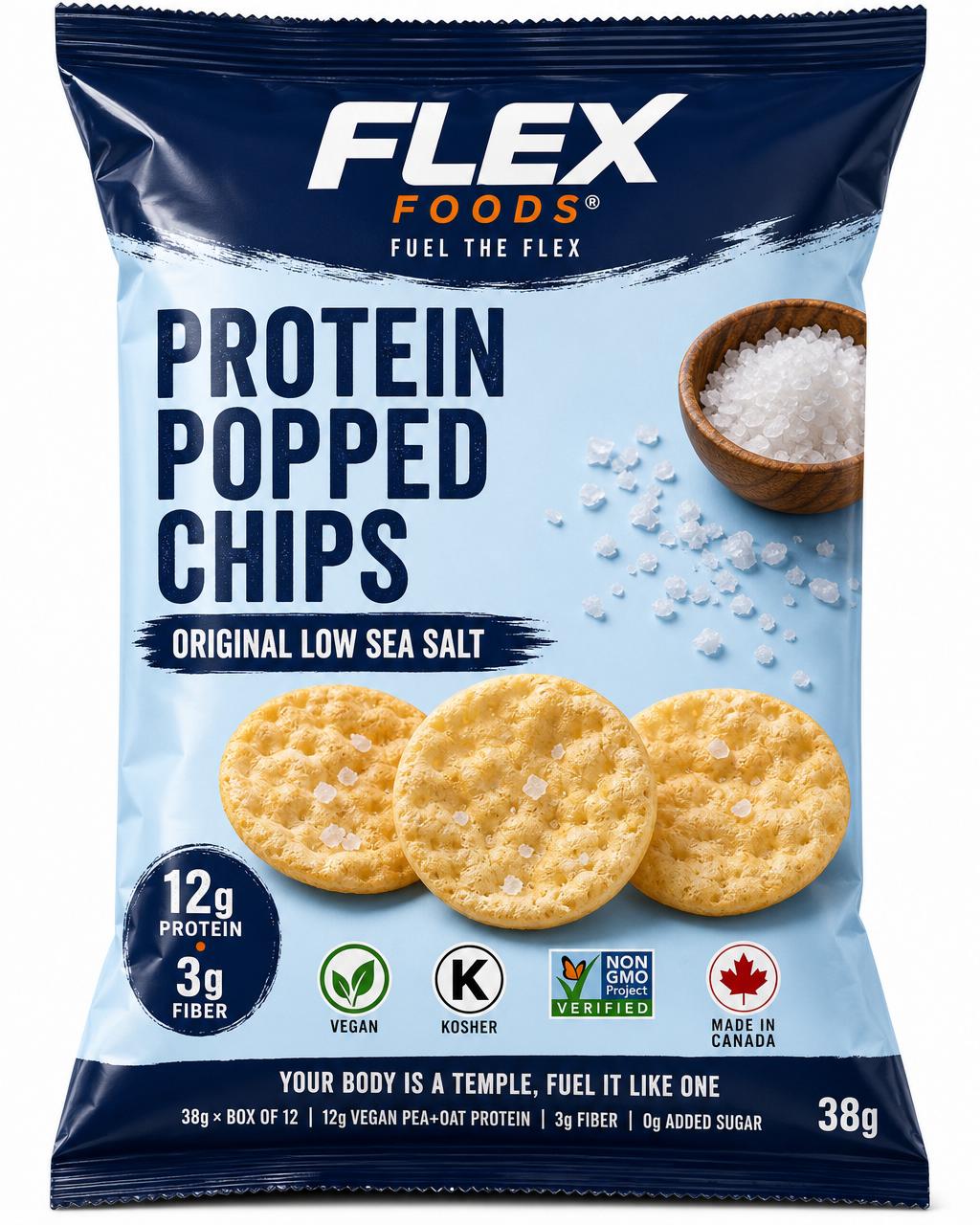
Protein per 100 calories. Grams of protein ÷ calories × 100. Under 4 is a carbohydrate snack. Over 6 means protein is genuinely the point. Standard chips score about 0.9; a biscuit is under 1; a 38 g bag of Protein Popped Chips comes to 8.0.
Fibre. Under 1 g and it won't hold you. 3 g or more is doing real work — the mechanism is in the 3 g fibre detail.
Added sugars. In a savoury snack this should be 0 g. In a sweet one, anything above about 8 g is functionally a dessert, which is fine as long as you know that's what you're eating.
You'll find that most of pile B fails at least two of these. That's not a moral failing — it's what the snack aisle is optimised to sell.
Step 3: identify what the drawer is actually for
This is the step that makes the audit stick, and most people skip it.
A desk drawer serves three distinct functions, and stocking one item for all three is why it never works.
The bridge. Mid-afternoon, three hours from dinner, energy flat. Needs protein and fibre, under about 200 calories, savoury. This is the highest-volume slot.
The insurance. A meeting ate your lunch hour. Needs to function as a partial meal — 200–250 calories, 15–20 g of protein. A bar is genuinely better here than a snack; we compare them in protein chips vs protein bars.
The treat. Something you actually want, in a portion you decided on in advance. Pretending this slot doesn't exist is the fastest way to raid the shared biscuit tin.
Three slots, three items. Not one item you hope covers everything.
Step 4: the replacement rule
One rule, and it's about packaging as much as contents:
Every item must be single-serve, sealed, shelf-stable, and something you'd choose on purpose.
Each clause is load-bearing.
- Single-serve because portion decisions get made once per package, not once per mouthful. An open bag in a drawer is a bag you will finish.
- Sealed because an opened anything in a desk drawer becomes stale, then becomes waste.
- Shelf-stable because the office fridge is contested and unreliable.
- Something you'd choose on purpose because a snack you tolerate is a snack you'll abandon for the biscuit tin within a fortnight. Adherence beats optimisation over any real timeframe.
Step 5: rotation, which is the part that fails
Here's the failure mode that undoes almost every drawer reset.
You buy a case of one sensible item. You eat it enthusiastically for about eight working days. By week three you're actively avoiding it and the vending machine has won.
The cause is sensory-specific satiety: appetite for a specific flavour and texture declines with repeated exposure faster than appetite for food in general. It is not a discipline problem. It will defeat any single-item plan, no matter how good the item is.
Two fixes, both structural:
- Stock three to four different items rather than a case of one.
- Prefer variety packs where they exist. Six flavours of the same snack means the sensory experience changes daily while the nutrition doesn't — 12 g of protein whether it's Tikka Masala or Original Sea Salt. It's the main practical argument for buying a variety case.
Step 6: restock on a day, not on empty
Pick a day. Monday morning, or Friday afternoon. Put it in the calendar.
An empty drawer is discovered at 3pm when you're flat and the only alternative is whatever's in the kitchen. That moment is where the whole system gets decided, and you want it to never arrive.
What the audit usually finds
In our experience of asking people to do this: one genuinely good item, three things eaten purely by proximity, and one aspirational purchase from last spring.
The fix takes ten minutes and one order. It's a small intervention with a disproportionate return, because it changes what's within reach at the exact moment you stop making decisions. For the team-scale version, see our office restock list.