Fuel Science
Creatine vs BCAAs: What Each Actually Does
Two of the highest-selling sports supplements, with very different evidence bases behind them.
Creatine and BCAAs sit next to each other in every supplement shop and get bought together constantly. Their evidence bases are not comparable, and it's worth seeing why side by side.
What each is
Creatine is an amino acid derivative — a small nitrogen-containing molecule your body synthesises at about a gram a day from arginine, glycine and methionine. Stored in muscle as phosphocreatine, it regenerates ATP during the first seconds of maximal effort.
BCAAs are leucine, isoleucine and valine — three of the nine essential amino acids, which must come from diet. Leucine activates mTORC1, the signalling complex that initiates muscle protein synthesis.
One is an energy buffer. The other is a signalling input and building material.
The evidence comparison
| Creatine | BCAAs | |
|---|---|---|
| Human trials | Several hundred | Substantial, more contested |
| Strength / lean mass | Consistent effect with training | Submaximal vs whole protein |
| Obtainable from food | Impractically — see below | Readily and abundantly |
| Superseded by a cheaper option? | No | Yes — whole protein |
| Evidence tier (AIS framework) | Highest | Not in the highest group |
| Non-responders | ~20–30% | Depends on protein intake |
The asymmetry that decides it
Both are found in food. The difference is whether food can realistically deliver a supplemental-equivalent amount.
BCAAs: easily. Whey is roughly a quarter BCAA by weight, so 25 g of whey delivers around 5–6 g of BCAAs plus all the other essential amino acids needed to actually build with. Meat, eggs, dairy, soy and legumes all supply them substantially.
So a BCAA supplement delivers a subset of what a cheaper, more complete option already provides.
Creatine: not really. Matching a 3 g dose would require roughly 600–750 g of raw beef daily before cooking losses — around 1,500 calories of beef, with substantial saturated fat and cost. See where creatine comes from in food.
That asymmetry is the whole comparison. Creatine supplementation delivers something food realistically can't at the relevant dose. BCAA supplementation delivers a fraction of something food delivers better.
The BCAA critique, stated fairly
Muscle protein synthesis builds from all nine essential amino acids. BCAAs supply three.
Leucine triggers the process, but construction is limited by whichever required amino acid runs out first — leaving six potential limiters. Researchers including Wolfe have argued BCAAs alone cannot maximally stimulate synthesis, and studies measuring the response have found BCAA ingestion produces a real but submaximal increase compared with whole protein.
The reasonable summary: if your protein intake is adequate, BCAAs add little. If it isn't, more total protein is the better solution. See do BCAAs work if you eat enough protein.
Where BCAAs are more defensible
Two cases worth granting.
Training fasted. If you train early with nothing in the stomach and don't want a full protein feeding, BCAAs are low-calorie and rapidly absorbed. Complete essential amino acids or a small whole-protein dose would still likely be better.
Soreness. Some trials report modest reductions in delayed-onset soreness and damage markers. Findings are inconsistent, but it's the more defensible claim.
Where creatine loses
Not everywhere, and it's worth naming.
Roughly 20–30% of people are non-responders, usually because baseline muscle stores were already near capacity. Essentially nobody is a "protein non-responder."
It adds 1–2 kg of intracellular water, which matters in weight-class and power-to-weight sports. BCAAs don't.
It does nothing for aerobic endurance. Neither does anything much for that, in fairness.
If you're choosing
Creatine, and it isn't close — provided you train in a way that involves short maximal efforts, and provided your protein intake is already adequate.
If your protein intake isn't adequate, neither is the answer. More total protein is.
See the five supplements with the strongest evidence for where both sit in the wider picture.
About this blog
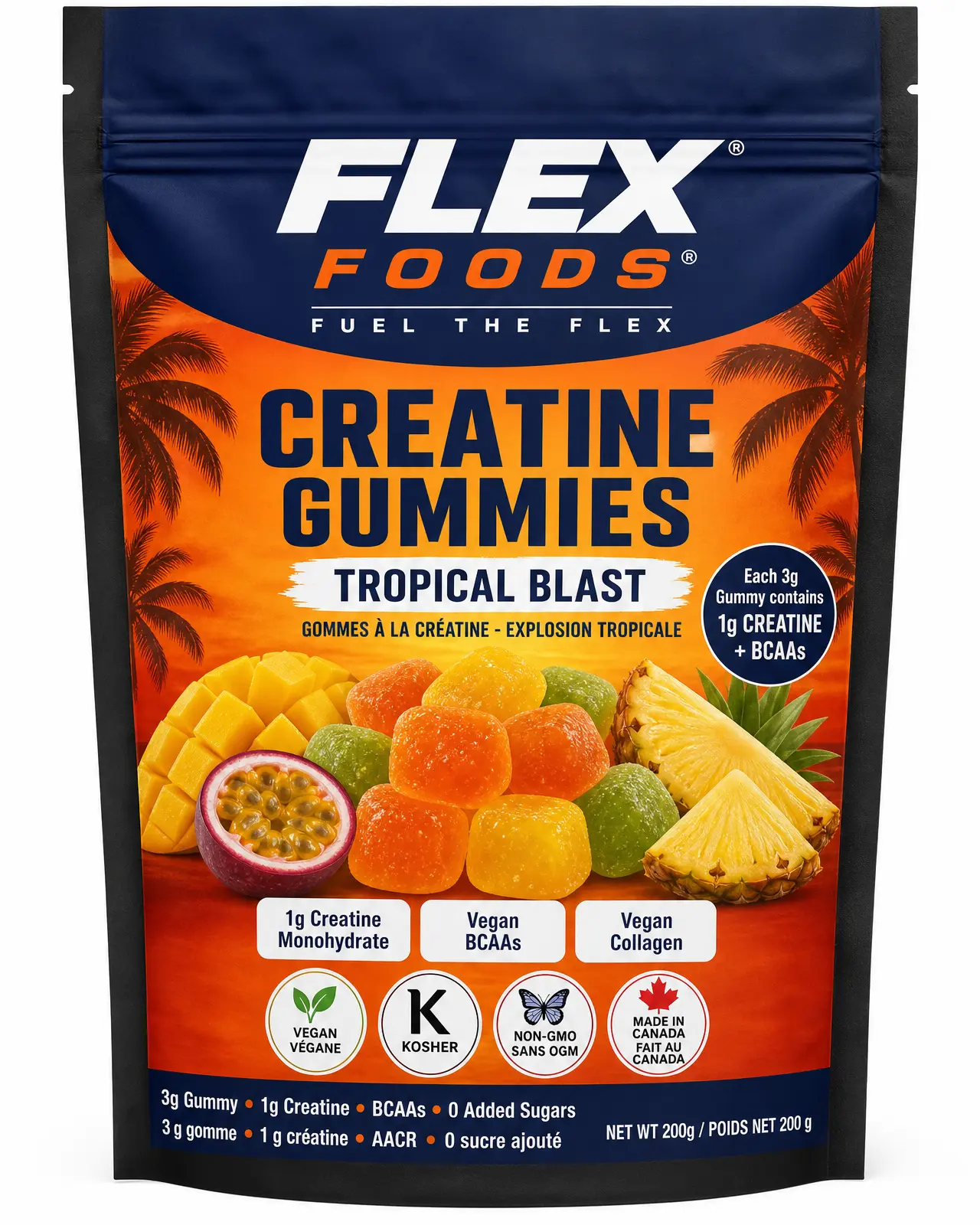
Our medicinal ingredient is creatine monohydrate, 1 g per gummy. Our nutrition panel declares 0 g protein. We don't sell BCAAs, and this comparison is here because people ask for it.
General information about a natural health product, not medical advice.