
Nutrition 101
Where Creatine Comes From in Food
Red meat and fish carry a gram or two per pound, and cooking destroys some. Why diet alone rarely fills the tank.
Creatine isn't a synthetic invention. It's a compound found in vertebrate muscle tissue, which means you've been eating it your whole life if you eat meat or fish.
How much, and whether it's enough, is the interesting part.
Where it's found
Creatine is stored in muscle, so the food sources are animals' muscles. Approximate figures for raw uncooked flesh:
| Food | Approx. creatine per kg raw |
|---|---|
| Herring | 6–10 g |
| Pork | ~5 g |
| Beef | 4–5 g |
| Salmon | ~4.5 g |
| Tuna | ~4 g |
| Cod | ~3 g |
| Chicken | ~3 g |
| Milk | ~0.1 g |
| All plant foods | Effectively none |
Figures vary by cut, species and source — treat them as orders of magnitude rather than precise values.
In everyday terms: a 200 g raw beef steak carries roughly a gram of creatine. A large salmon fillet, similar.
Cooking destroys some of it
The detail that undercuts the food-first argument.
Creatine converts to inert creatinine in the presence of heat and moisture — the same reaction that makes creatine gummies difficult to formulate. Cooking meat provides exactly those conditions.
Prolonged, high-heat, wet cooking loses the most. A slow-braised stew or a well-done steak retains less creatine than a rare one, and creatine leaching into cooking liquid is lost unless you consume it.
So the table above describes raw food. What reaches you is somewhat less. Detail on the chemistry in why creatine degrades in water.
What a typical diet delivers
An omnivore eating meat or fish most days takes in roughly 1–2 grams of creatine daily from food.
Combined with the roughly 1 g a day your body synthesises, that's 2–3 g of daily input against a turnover of about 2 g — enough to sit at a reasonable but not maximal level of muscle saturation. Most omnivores land somewhere around 60–80% of the muscle's storage ceiling.
Supplementation fills the remainder. See how much creatine per day.
Why you can't practically eat your way to saturation
Run the arithmetic on matching a 3 g supplemental dose through food alone.
At roughly 4–5 g of creatine per kilogram of raw beef, 3 g means around 600–750 g of raw steak — before accounting for cooking losses. Daily. Indefinitely.
That's roughly 1,500 calories of beef, substantial saturated fat, considerable cost, and an intake of red meat well above what most dietary guidance suggests. Herring would be more efficient and few people want a kilogram of herring a week for this reason.
So creatine is one of the genuinely rare cases where a supplement delivers something that's impractical to obtain from food at the relevant dose — not because the nutrient is absent from food, but because the food density is too low.
Which is why plant-based eaters start lowest
Plants contain essentially no creatine. A vegan's dietary intake is close to zero, leaving endogenous synthesis of about a gram a day as the only input.
Studies measuring muscle creatine have consistently found lower stores in vegetarians and vegans than in omnivores. Lower baseline means more headroom, and generally a larger response to supplementation.
It's the population where the case for creatine is clearest. See creatine for vegans and vegetarians.
The synthetic creatine question
People sometimes assume supplemental creatine is extracted from meat. It isn't.
Commercial creatine monohydrate is produced by chemical synthesis, typically from sarcosine and cyanamide. The resulting molecule is identical to what's in a steak and what your liver makes — same compound, different origin.
Which is why creatine monohydrate is suitable for vegans, and why the thing to check on any creatine product is the delivery format rather than the creatine. Capsule shells are often gelatin; conventional gummies are set with gelatin. Ours use pectin. See pectin vs gelatin.
The practical summary
Food gives an omnivore 1–2 g daily and a plant-based eater essentially none. Cooking reduces both. Reaching a supplemental-equivalent intake through food alone would require impractical quantities of meat.
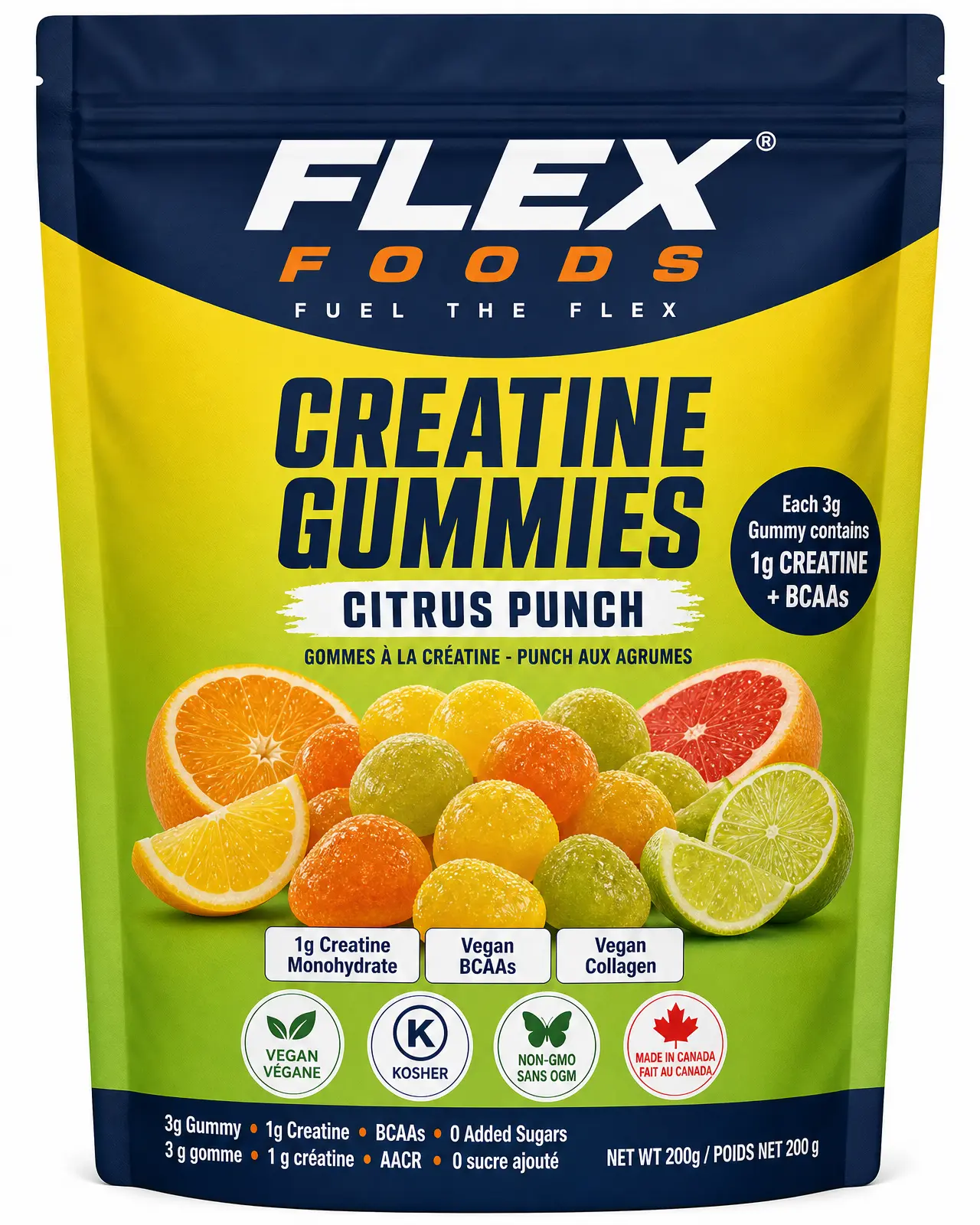
Three of our gummies deliver 3 g of creatine monohydrate — roughly what 600–750 g of raw beef would provide, before cooking losses.
General information about a natural health product, not medical advice.