Fuel Science
Creatine Monohydrate vs Every Other Form
HCl, ethyl ester, buffered, liquid, nitrate. Thirty years on, monohydrate is still the one with the evidence.
Walk into any supplement shop and you'll find creatine sold in half a dozen chemical forms, most positioned as improvements on monohydrate — better absorbed, no bloating, no loading required, more soluble.
Almost none of those claims survive contact with the comparison data. Here's the state of play.
Creatine monohydrate: the reference standard
Creatine bound to a single water molecule. It is the form used in the overwhelming majority of the several hundred human trials on creatine, and it's what every position stand recommends.
Advantages: the evidence base, an excellent safety record over decades, very high bioavailability, and by far the lowest cost per gram.
The genuine criticisms: it dissolves poorly in cold water and can feel gritty, and large single doses cause stomach upset in some people. Both are real, and both are about the drinking experience rather than the effect.
A note on micronized monohydrate: this is the same molecule milled to a smaller particle size, which improves suspension and may reduce grittiness and digestive complaints. Same compound, better handling. It's a legitimate refinement rather than a different form.
Creatine HCl
Creatine bound to hydrochloric acid. Marketed heavily on solubility — and the solubility claim is true, it dissolves far better than monohydrate.
The problem is the inference. Better solubility in a glass is presented as better absorption in a body, and that doesn't follow. Monohydrate is already absorbed at very high efficiency — there isn't much room to improve on it.
HCl is also usually sold at smaller doses (often 750 mg–1.5 g) on the premise that less is needed. That premise doesn't have good supporting evidence, and direct head-to-head trials against monohydrate on performance outcomes are scarce.
Verdict: probably works, costs considerably more, has a fraction of the evidence, and the dose reduction is unsupported.
Creatine ethyl ester
The clearest case of a form that's actually worse.
The theory was that esterification would improve cell membrane permeability. What research found instead is that creatine ethyl ester is rapidly degraded to creatinine — the inert breakdown product — in the acidic environment of the stomach, and does so faster than monohydrate.
Head-to-head work has found it produced smaller increases in muscle creatine than monohydrate, with higher serum creatinine reflecting the degradation.
Verdict: avoid.
Buffered creatine (Kre-Alkalyn)
Alkaline-buffered creatine, sold on the claim that raising pH prevents conversion to creatinine in the stomach and therefore requires a smaller dose.
A head-to-head trial against monohydrate found no advantage on muscle creatine content, body composition or performance, at either equivalent or the recommended lower doses.
Verdict: no demonstrated advantage over a cheaper form.
Liquid creatine
The one that runs directly into chemistry. Creatine in aqueous solution converts to creatinine over time, and that conversion is accelerated by acidity and heat.
A pre-dissolved liquid product sitting on a shelf for months is exactly the condition under which creatine degrades. Analyses of liquid creatine products have found low creatine content and elevated creatinine.
Verdict: the format works against the molecule.
Worth noting this is the same chemistry that makes gummies harder to formulate than powder — a point we make about our own product in gummies vs powder and why creatine degrades in water.
Creatine nitrate, magnesium chelate and the rest
Various salts and complexes, each with a mechanistic story and a thin evidence base. Some may work perfectly well — the issue isn't that they're harmful, it's that you'd be paying a premium for less certainty than monohydrate offers at a lower price.
The summary table
| Form | Evidence | Cost | Verdict |
|---|---|---|---|
| Monohydrate | Extensive | Lowest | The default |
| Micronized monohydrate | Same compound | Low | Fine — easier to mix |
| HCl | Limited | High | Probably fine, unnecessary |
| Ethyl ester | Negative | High | Avoid |
| Buffered | No advantage found | High | Unnecessary |
| Liquid | Stability problems | High | Avoid |
| Nitrate / chelates | Thin | High | Unproven |
What we use, and why
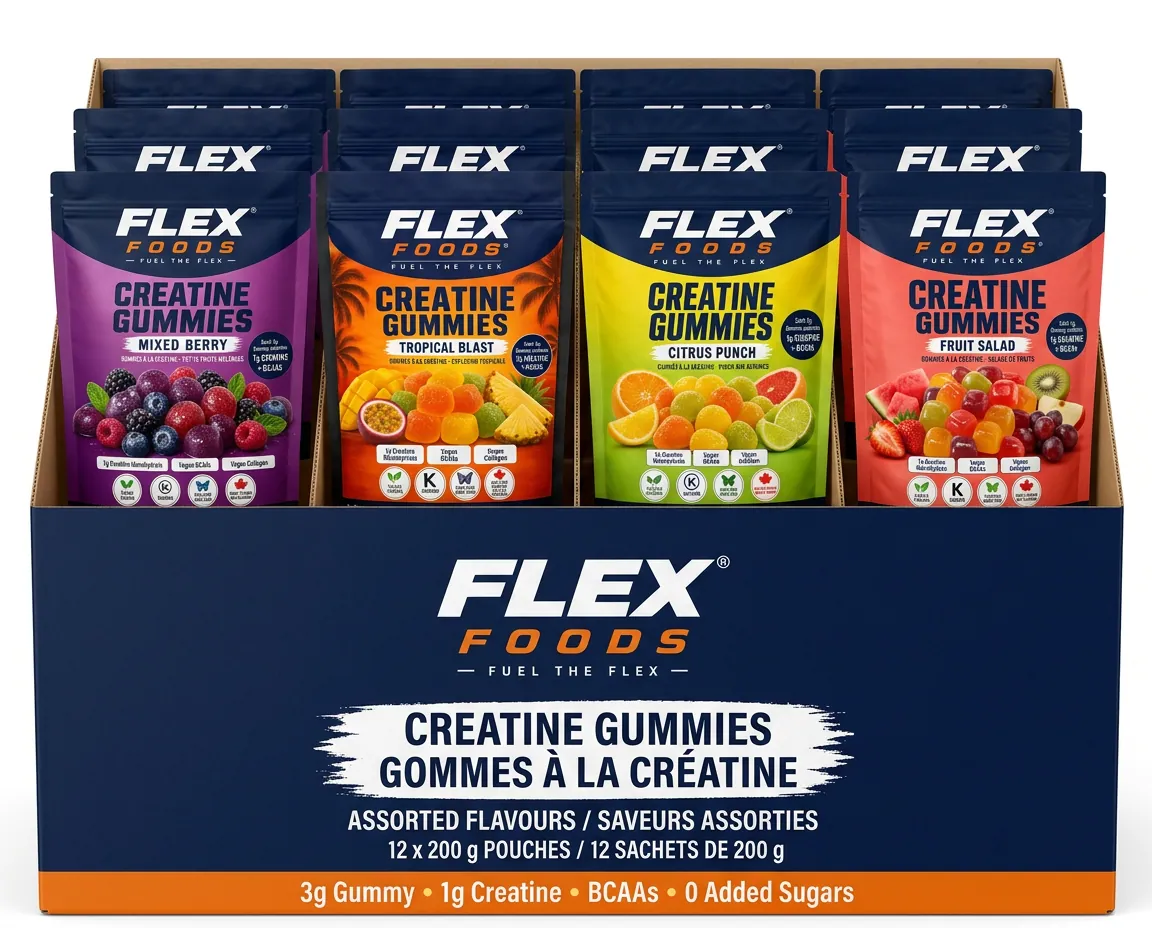
Our gummies contain creatine monohydrate, 1 g per 3 g gummy. It's the declared medicinal ingredient on the label.
The reason is the same one that applies to everyone: it's the form the evidence is built on, and there's no demonstrated reason to use anything else.
Which means the meaningful question about our product isn't which form of creatine it uses — it's whether the monohydrate survives manufacturing and shelf life at the declared amount. That's the right thing to interrogate, and we've written about how to interrogate it in how to check a creatine gummy actually contains creatine.
General information about a natural health product, not medical advice.