Nutrition 101
Allergen Labelling in Canada: The 'May Contain' Decoder
Priority allergens, 'Contains' statements and precautionary labelling. What's mandatory, what's voluntary, and how to make a call.
Canadian allergen labelling is stronger than most people realise in one respect and weaker in another. Knowing which is which is the difference between reading a label usefully and reading it anxiously.
This is a reference post. General information rather than medical advice — if you or someone you feed has a diagnosed allergy, your allergist's guidance governs.
The priority allergens
Canada designates a specific list that must be declared whenever present as an ingredient or component:
- Peanuts
- Tree nuts — almonds, Brazil nuts, cashews, hazelnuts, macadamia nuts, pecans, pine nuts, pistachios, walnuts
- Milk
- Eggs
- Fish
- Crustaceans and molluscs
- Sesame seeds
- Soy
- Wheat and triticale
- Mustard
Plus sulphites, which are handled alongside the priority allergens, and gluten sources — wheat, barley, rye, oats, triticale and their hybrids.
What's mandatory
Three things, and they're the load-bearing protections.
1. Declaration in plain language. A priority allergen present as an ingredient or component must be named using its common name — "milk," not "casein" alone; "wheat," not just "semolina." It appears either in the ingredient list or in a separate "Contains" statement immediately after it.
2. Class names cannot conceal allergens. This is the important one. Ingredients like "natural flavour," "spices" and "colour" may be declared as class names without listing components — but if a priority allergen is in there, it must still be declared. A class name is never a hiding place for an allergen. More on that in reading natural flavour.
3. Components of ingredients count. If an ingredient is itself a compound containing an allergen, the allergen must be declared. You don't have to trace ingredient chains yourself.
What's voluntary — and this is the gap
Precautionary allergen labelling is not required in Canada. "May contain," "produced in a facility that also processes," "made on shared equipment" — all voluntary.
Two consequences, and both matter.
Its presence isn't uniform. A "may contain" statement covers everything from a genuinely shared production line with real cross-contact risk to an abundance-of-caution statement on a dedicated line in a multi-allergen building. The label doesn't distinguish, and the risk is genuinely different.
Its absence proves nothing. A product without a precautionary statement may still be made on shared equipment. The manufacturer may have assessed the risk as negligible, or simply chosen not to state it. This is the counterintuitive half, and it's the reason a clean-looking label isn't the same as a verified one.
Health Canada's guidance is that people with food allergies should avoid products carrying a precautionary statement for their allergen. That's the safe rule and we won't second-guess it.
When a statement is ambiguous and the stakes are high, phoning or emailing the manufacturer is genuinely worth the few minutes. Most food companies will tell you exactly what the line runs and how it's cleaned between products.
Our own label, stated plainly
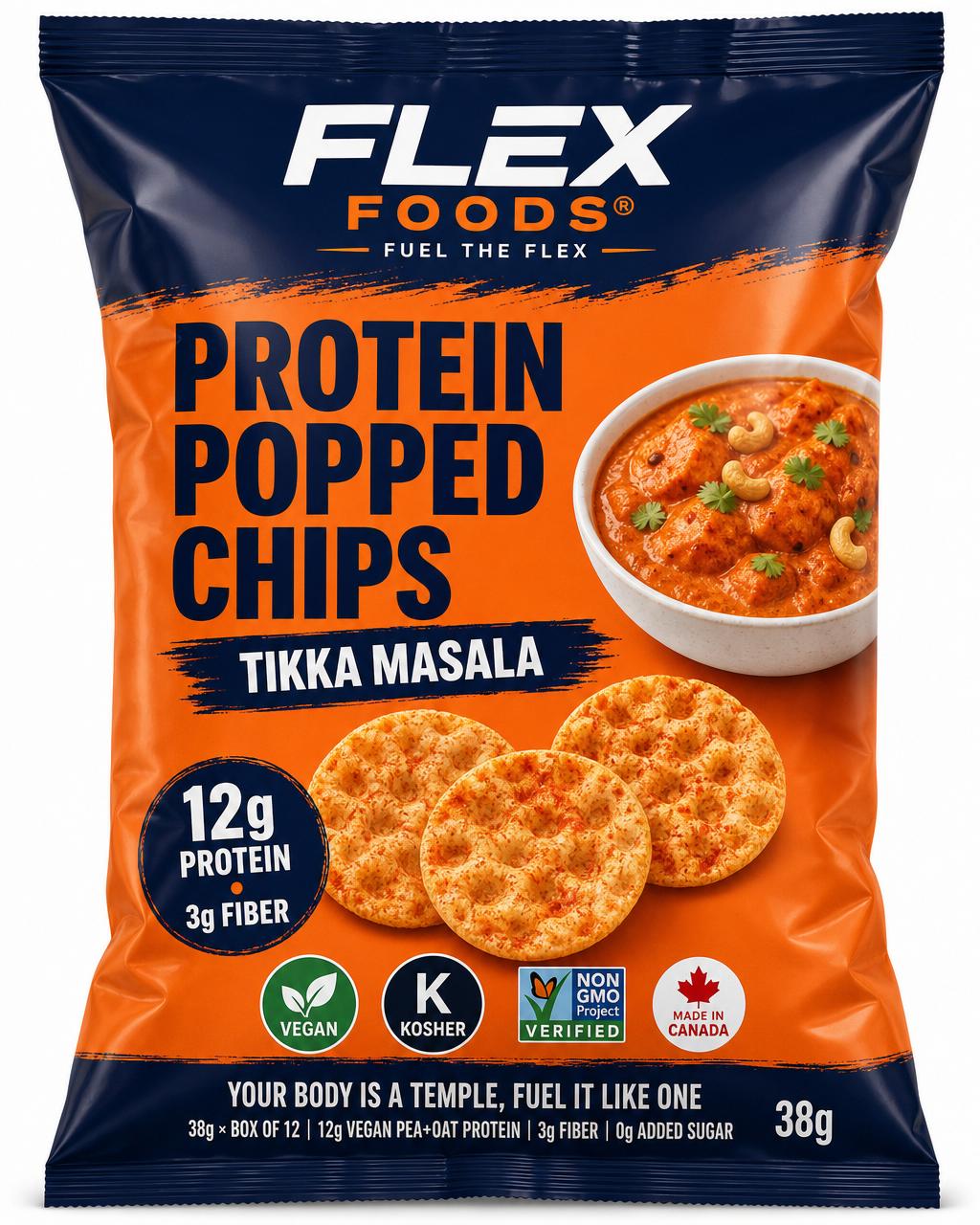
The ingredient list for Protein Popped Chips is: pea protein isolate, oat protein, brown rice, sunflower oil, natural seasoning, sea salt, spices.
The allergen statement on the bag reads "May contain oats."
Reading that properly: oat protein is an intentional ingredient — it's what closes the methionine gap in pea protein, as described in the pea-plus-oat amino acid story. The precautionary statement reflects the oat supply chain, where sharing with wheat is common enough that it's the default rather than the exception.
The list contains no peanuts, tree nuts, milk, eggs, fish, shellfish, sesame, soy or mustard. Soy's absence is deliberate — it's the other obvious complete plant protein and we left it out because it's a priority allergen and a common sensitivity.
If you're managing a severe allergy, or feeding a child in a nut-free school, don't rely on that summary. Email hello@flexfoods.ca for current facility allergen documentation for the lot you're holding, and check it against your requirements. A parent managing anaphylaxis risk deserves paperwork rather than a paragraph.
The coeliac question specifically
Worth separating from allergy.
Canada regulates gluten-free as a claim: it requires no gluten protein from wheat, barley, rye, oats or triticale, and Health Canada considers products under 20 parts per million to meet the standard.
Oats complicate this. They don't naturally contain gluten, but conventional oat supply chains share equipment and transport with wheat. Gluten-free claims are permitted on products using specially produced uncontaminated oats.
Our bag carries a gluten-free claim and a "may contain oats" statement. Both are accurate, and if you have coeliac disease that combination is exactly the detail worth scrutinising rather than taking on trust. Contact us for the certification documentation. Fuller treatment in the gluten-free and soy-free guide.
The reading order
- Ingredient list first. It's regulated; the front of the package is marketing.
- "Contains" statement. Mandatory when a priority allergen is present.
- Precautionary statement. Voluntary, and it means what it says.
- Contact the manufacturer if the stakes are high and the label is ambiguous.
- Then the nutrition panel. Safe to eat and worth eating are different questions.
One more thing worth knowing: if you have a reaction to a product, you can report it to the CFIA. Recalls are frequently triggered by consumer reports of undeclared allergens, and reporting is how the system actually catches labelling failures.