Brand & Values
Kosher Certification, Explained for Snack Shoppers
What a symbol on a chip bag actually certifies, who audits it, and why a bare K is weaker evidence than you'd think.
Kosher symbols appear on an enormous share of packaged food in Canada — far more than the observant Jewish population would suggest. Plenty of people buy kosher-certified products without knowing what the certification covers, and some use it as a general proxy for oversight.
Here's what it does and doesn't tell you, including a candid note about the symbol on our own bag.
What kashrut actually governs
Kosher — kashrut — is a body of Jewish dietary law derived from the Torah and developed through rabbinic literature. The core rules relevant to packaged food:
- Permitted and forbidden species. Only certain animals are permitted; pork and shellfish are the best-known exclusions.
- Slaughter method. Permitted animals must be slaughtered according to shechita by a trained shochet.
- Separation of meat and dairy. They may not be cooked or eaten together, and require separate equipment. This is the rule that generates most of the complexity in manufacturing.
- Ingredient derivation. Every ingredient, including processing aids and flavourings, must itself be kosher — which is where most industrial food gets complicated, since a single "natural flavour" may contain dozens of components.
- Equipment status. Shared equipment can transfer status. A line that ran a dairy product affects the next product on it.
The three designations you'll see
Most certified products carry one of these alongside the agency mark:
- Pareve (or parve) — neither meat nor dairy. Can be eaten with either.
- Dairy (often D) — contains dairy or was made on dairy equipment.
- Meat (often Meat or Glatt) — contains meat or meat derivatives.
You'll also see Kosher for Passover (or P), a stricter standard prohibiting leavened grain products during Passover. This one catches people out: a product kosher year-round is frequently not kosher for Passover, and grain-based snacks are a common example.
The part most shoppers don't know: not all symbols are equal
This is the genuinely useful thing in this post.
A plain letter K cannot be trademarked — a single letter isn't registrable as a mark. Which means anyone can print a K on a package, and its presence does not by itself establish that a recognised agency audited anything. Some products bearing a bare K are certified by a reputable authority. Others are self-declared.
By contrast, agency marks are registered trademarks and can only be used under licence following actual certification:
- COR — Kashruth Council of Canada, the largest Canadian agency
- OU — Orthodox Union, the largest worldwide
- BCK — BC Kosher, based in Vancouver
- MK — Montreal Kosher
- Kof-K, OK, Star-K — other widely recognised agencies
If you keep kosher, look for one of these rather than a bare letter. If you're using kosher status as a general proxy for supply-chain oversight, the same advice applies for the same reason.
What's on our bag, honestly
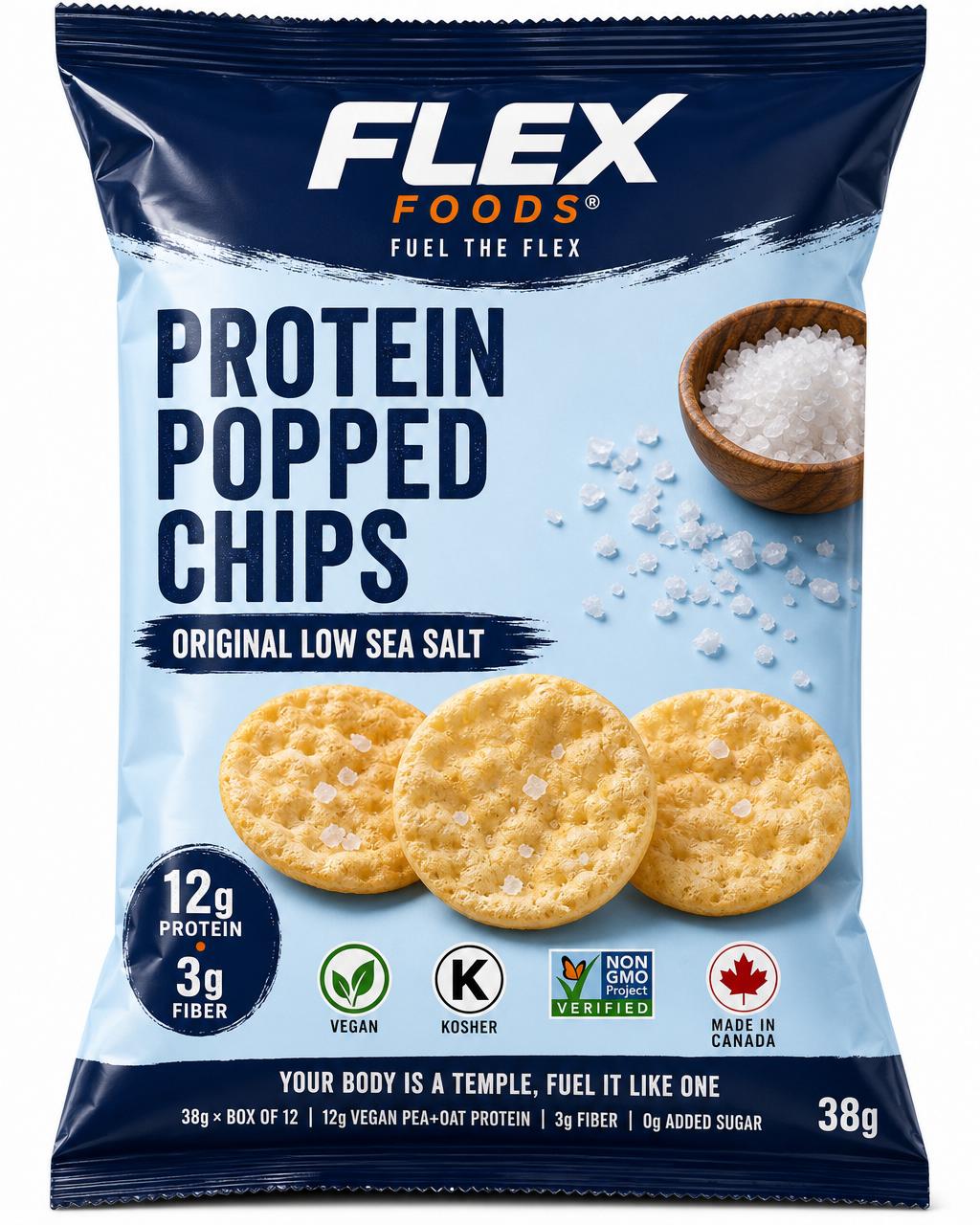
Our packaging carries a K symbol. Given what we just said, that deserves a straight answer rather than a reassuring one.
A bare K is weaker evidence than a named agency mark, and if you keep kosher strictly you should not treat it as sufficient. Email hello@flexfoods.ca for the current certifying authority and certificate for the lot you're holding, and if we can't produce one, that's information you're entitled to have.
We'd rather flag this than let a symbol do work it may not be doing. It's the same principle we applied to our own allergen and gluten labelling — the details a customer with a real constraint needs are the details worth being precise about.
Why non-Jewish shoppers buy kosher
Several reasons, some sound and some overstated.
Reasonably sound:
- Dairy avoidance. A pareve designation means no dairy, verified by an auditor. For lactose intolerance or dairy allergy this is genuinely useful supplementary information — though it does not replace the mandatory allergen declaration, which is the legally binding statement.
- Ingredient traceability. Kosher certification requires documenting the derivation of every ingredient, including flavourings and processing aids. That's a real paper trail.
- Halal overlap. Partial and imperfect. Kosher pareve products avoid pork and are usually acceptable, but kosher certification does not address halal requirements around alcohol or slaughter, and they are not interchangeable.
Overstated: kosher certification says nothing about nutrition, additives, sugar content, ultra-processing or ingredient quality. A kosher-certified product can be nutritionally poor, and many are. It's a religious standard with an auditing apparatus attached, not a health standard.
The one-line version
A named agency mark means a specific organisation inspected the ingredients, equipment and process. A bare K means considerably less. And neither tells you anything about whether the food is good for you — for that, read the panel. Our walkthrough is in the nutrition facts explained.