
Training
Creatine for Strength Training: The Core Use Case
The core use case, and the one with the most evidence. What the effect size actually looks like in a training log.
If creatine has a home application, this is it. Resistance training is where the evidence is deepest, the mechanism is clearest, and the effect is most reliable.
Worth being specific about how large that effect actually is, because both the marketing and the scepticism tend to overshoot.
Why strength training is the ideal match
A set of five to twelve reps takes roughly 20 to 45 seconds. Rest between sets runs one to three minutes.
That's almost exactly the profile the phosphocreatine system governs. The first seconds of each set draw heavily on stored phosphocreatine, and the rest period is when it's resynthesised for the next set.
More stored phosphocreatine does two things: it extends how long you can maintain output within a set, and it speeds resynthesis between sets. Both compound across a session.
The effect size
Meta-analyses pooling resistance training trials have consistently found creatine groups outperforming placebo groups on strength outcomes.
Frequently cited work by Rawson and Volek found that creatine plus resistance training produced roughly 20% greater increases in maximal strength compared with training plus placebo, and around 26% greater increases in weightlifting performance measured as maximal repetitions at a given percentage of 1RM.
Those are percentages of the improvement, not of your total strength. If training alone would have added 10 kg to your bench press over twelve weeks, creatine might make it 12 kg. Real, worthwhile, and not transformative.
Similar analyses have found greater gains in lean body mass, with the caveat that a portion of early lean mass change reflects intracellular water rather than contractile tissue. See creatine and water retention.
What it looks like week to week
The mechanism is worth restating because it changes what you should look for: creatine doesn't make you stronger, it lets you do more work, and the work makes you stronger.
Concretely, once saturated:
- An extra rep or two at a given load
- Less drop-off across sets — set four looks more like set one
- Slightly better recovery between sessions
None of that feels dramatic in the moment. Accumulated across four sessions a week for three months, it's a meaningful difference in total training volume, and volume is a primary driver of adaptation.
This is why a training log matters more than a scale for assessing whether creatine is working. Note reps at a fixed load on two or three main lifts before you start, and compare after eight weeks.
Where it helps most within a session
Strongest: multiple sets in the 3–12 rep range with short to moderate rest. Compound lifts. Anything where set-to-set fatigue is the limiting factor.
Moderate: singles and heavy doubles. Maximal effort draws on phosphocreatine, but a single rep doesn't deplete it much, so the between-set recovery advantage matters more than within-set capacity.
Weakest: very high-rep work above 20 reps, where glycolysis dominates and phosphocreatine contributes less.
The prerequisite
Creatine's strength benefit is inseparable from progressive resistance training. Every study demonstrating it involved a training programme.
Which means the honest order of operations is: train consistently with progressive overload, eat enough protein and total energy, sleep, and then add creatine to make the training slightly more productive.
Adding creatine to inconsistent training produces very little.
Dosing for strength training
Standard maintenance — 3–5 g daily, weight-adjusted. Larger lifters with more muscle mass sit at the top of the range or above it. See creatine dose by bodyweight.
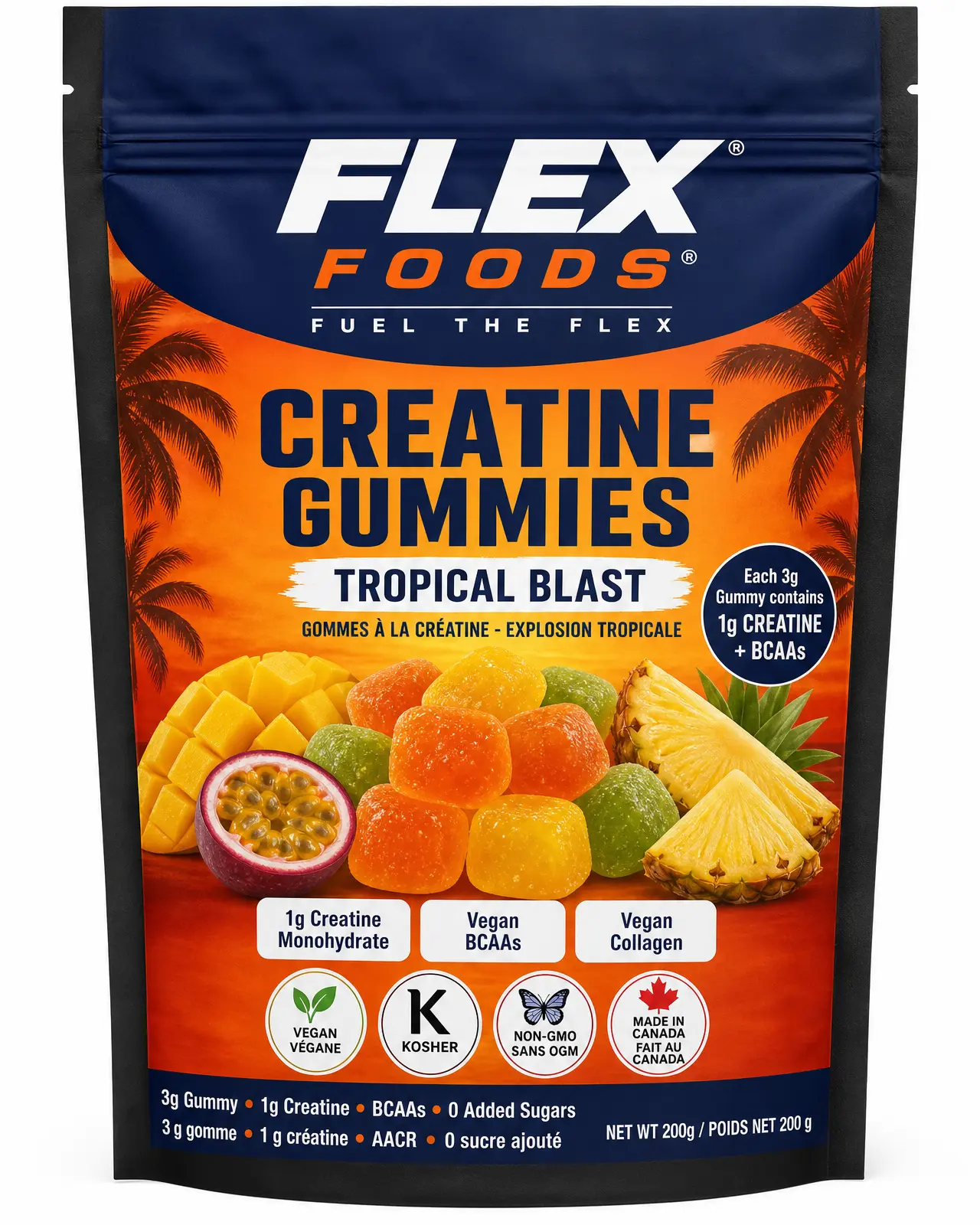
Our gummies deliver 1 g of creatine monohydrate per 3 g gummy, with a label serving of three gummies for 3 g daily. For a lifter above roughly 90 kg that's the low end, and four or five gummies — or topping up with powder — is closer to appropriate.
Timing is a minor variable. Daily consistency, including rest days, is what maintains saturation. See creatine timing.
Realistic expectations, stated plainly
What to expect: a few extra reps, better set-to-set consistency, roughly 1–2 kg of scale weight from intracellular water, and modestly better strength and size outcomes over months of training.
What not to expect: an acute effect you can feel, a transformation, or anything at all without training. Roughly 20–30% of people are non-responders, usually because baseline stores were already near capacity. See non-responders.
General information about a natural health product, not medical advice.