
Training
Protein for Over-40 Athletes: Why Needs Go Up, Not Down
Anabolic resistance means older athletes need more protein per meal, not less. What changes and what to do.
There's a widespread assumption that protein needs decline with age — that it's a young person's concern, tied to building rather than maintaining.
The evidence points the other way. Protein requirements appear to increase with age, and the reason is a phenomenon called anabolic resistance.
What anabolic resistance is
Give a 25-year-old and a 70-year-old the same 20 g dose of protein and measure the muscle protein synthesis response. The older adult's response is measurably blunted.
The muscle is less sensitive to the same amino acid signal. Several mechanisms are implicated — reduced digestion and absorption efficiency, impaired muscle blood flow delivering fewer amino acids to the tissue, and reduced sensitivity of the mTOR signalling pathway that triggers synthesis.
The practical consequence: the dose that reliably triggers a response in a younger adult may sit below the threshold in an older one. Same protein, less effect.
This matters because it compounds. Over decades, a slightly reduced synthetic response against ongoing muscle protein breakdown produces sarcopenia — the age-related loss of muscle mass and function that drives frailty, falls and loss of independence in later life.
When does it start?
Not at a birthday. Muscle mass typically peaks somewhere in the late twenties to thirties and declines gradually thereafter, with the rate accelerating past roughly 60. Anabolic resistance appears to develop progressively rather than switching on.
Forty is not a cliff. It's a reasonable point to start being deliberate about something that was previously automatic.
The numbers, with hedging
Figures from the literature, which vary and remain debated:
- Per meal, younger adults: roughly 0.24–0.4 g per kilogram of bodyweight to maximise the synthetic response
- Per meal, older adults: commonly suggested at 0.4–0.6 g per kilogram — meaningfully higher
- Daily, older adults: proposals commonly land in the 1.2–1.6 g per kilogram range, above the standard adult RDA of 0.8 g/kg, with higher figures for those training
For a 75 kg person over 40 who trains: roughly 30–45 g of protein per meal, three to four times a day, totalling something like 110–140 g.
The standard RDA of 0.8 g/kg was set to prevent deficiency, not to optimise muscle maintenance. It's a floor, and treating it as a target is a common mistake in this age group.
Leucine specifically
Since the trigger for muscle protein synthesis is largely leucine-dependent, and older muscle is less sensitive to it, leucine content becomes more relevant with age.
Practical implications:
- Aim for larger per-meal protein doses rather than more frequent small ones
- Where using plant proteins, favour combined sources — pea and oat, pea and rice — since single plant sources have lower leucine density than dairy. Our post on pea and oat amino acids covers this
- Don't leave breakfast as a 5 g protein meal. It's the most commonly missed feeding and the easiest to fix
The thing that matters more than protein
Being clear about relative importance: resistance training is the larger lever, and protein without it does very little.
Progressive resistance training remains effective into the eighties and nineties, with well-documented gains in strength and muscle mass in older populations. It also partially reverses anabolic resistance — trained muscle responds better to protein than untrained muscle at any age.
So the order of operations is: train against resistance two or three times a week, then make sure protein intake supports it. Not the other way round.
Our post on recovery is also relevant here — recovery capacity does change with age, and training frequency often needs adjusting even as intensity holds up.
Where snacks fit
The specific gap for this group is that per-meal thresholds are higher, so the standard low-protein breakfast and zero-protein snack pattern fails harder than it does in younger people.
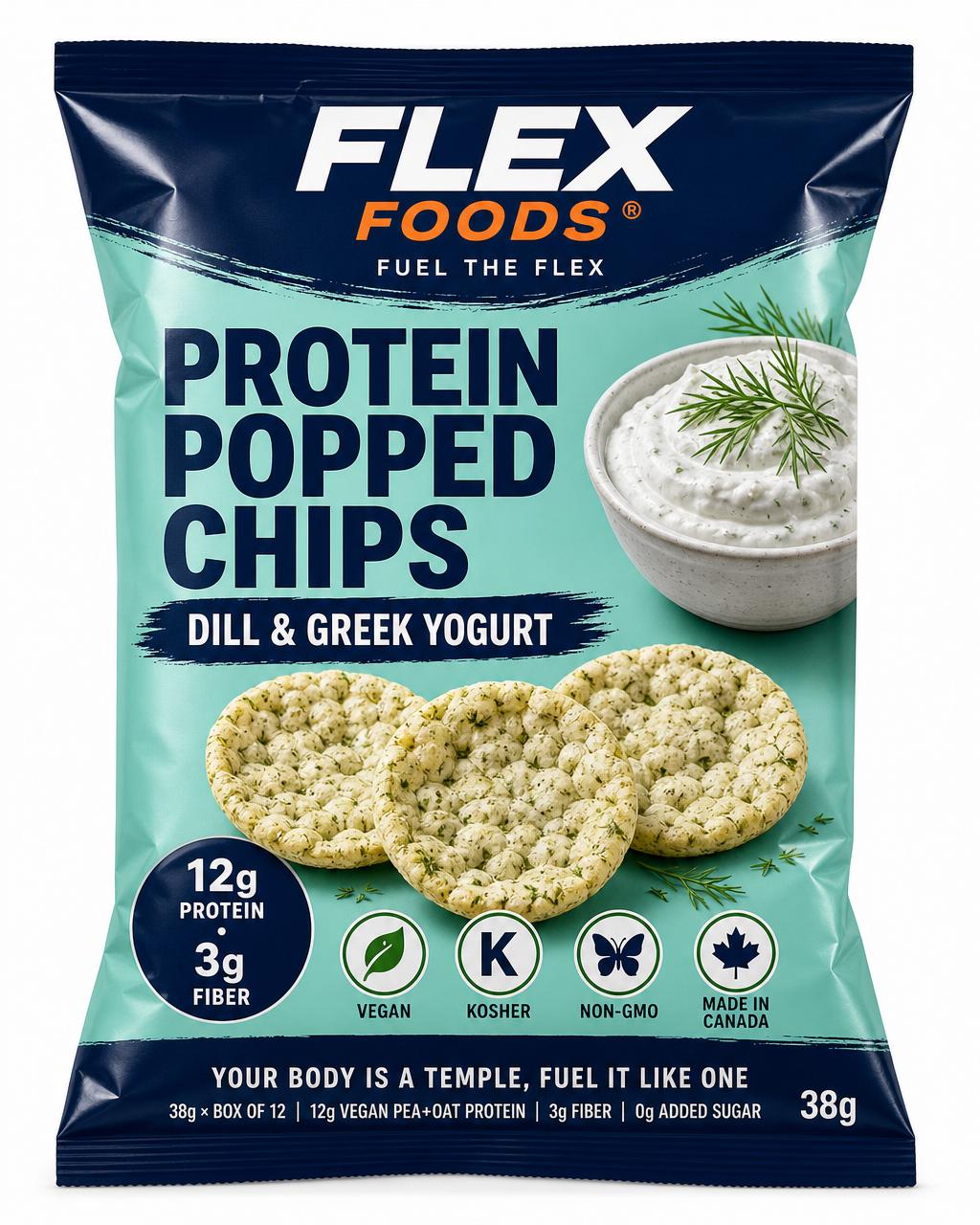
A 38 g bag of Protein Popped Chips is 12 g of protein — honestly, below a per-meal threshold for someone over 40, and useful as a component rather than a feeding.
Where it gets there: chips plus half a tin of black beans is 24 g. Plus a soy yogurt, 21 g. Plus roasted edamame, 23 g. Those clear the range. Combinations in five two-minute snack boards.
Two other age-relevant notes
Appetite often declines. Reduced appetite with age is common and makes hitting higher protein targets harder, not easier. Protein-dense foods and drinks become more useful precisely because volume is a constraint.
Vitamin D and calcium matter for the same outcome. Muscle and bone health are linked, and both nutrients are commonly low in older adults, particularly at Canadian latitudes over winter. Worth discussing with your doctor rather than self-supplementing — this is a case where blood work beats guessing.
General information, not individual advice. Anyone over 40 making significant changes to training or protein intake, particularly with kidney disease or other chronic conditions, should talk to their doctor or a registered dietitian first. Our post on protein myths covers the kidney question specifically.