
Nutrition 101
Do You Need a Protein Supplement If You Snack Well?
Running the numbers on whether food-first snacking can cover a normal training protein target.
Protein powder is a convenient, cost-effective, well-tolerated product, and the supplement industry has done a thorough job of convincing people it's necessary. It usually isn't.
Here's the arithmetic, done honestly by a company that sells food rather than powder — so weigh accordingly.
Set the target
Commonly cited figures for people training regularly land around 1.6 g per kilogram of bodyweight daily, with some evidence of additional benefit up to roughly 2.2 g/kg. The general-population RDA of 0.8 g/kg is a deficiency-prevention floor, not a performance target.
For a 75 kg person training four times a week: roughly 120 g a day.
A day that hits 120 g without powder
Plant-based, unremarkable food, nothing that requires a spreadsheet.
| Meal | Food | Protein |
|---|---|---|
| Breakfast | Oats with soy milk, 2 tbsp peanut butter, seeds | 25 g |
| Lunch | Lentil and grain bowl with tofu, greens | 32 g |
| Snack | Protein chips + half a tin of black beans | 24 g |
| Dinner | Tempeh stir-fry with rice and edamame | 35 g |
| Evening | Soy yogurt with pumpkin seeds | 14 g |
| Total | 130 g |
That clears the target with room to spare, across four or five feedings — which also satisfies the distribution question. No powder anywhere.
Note where the protein actually comes from: legumes and soy do the heavy lifting. Tofu, tempeh, lentils, beans, edamame and soy milk are the backbone of any plant-based diet that hits a high protein target, and they're cheap.
Where the snack fits
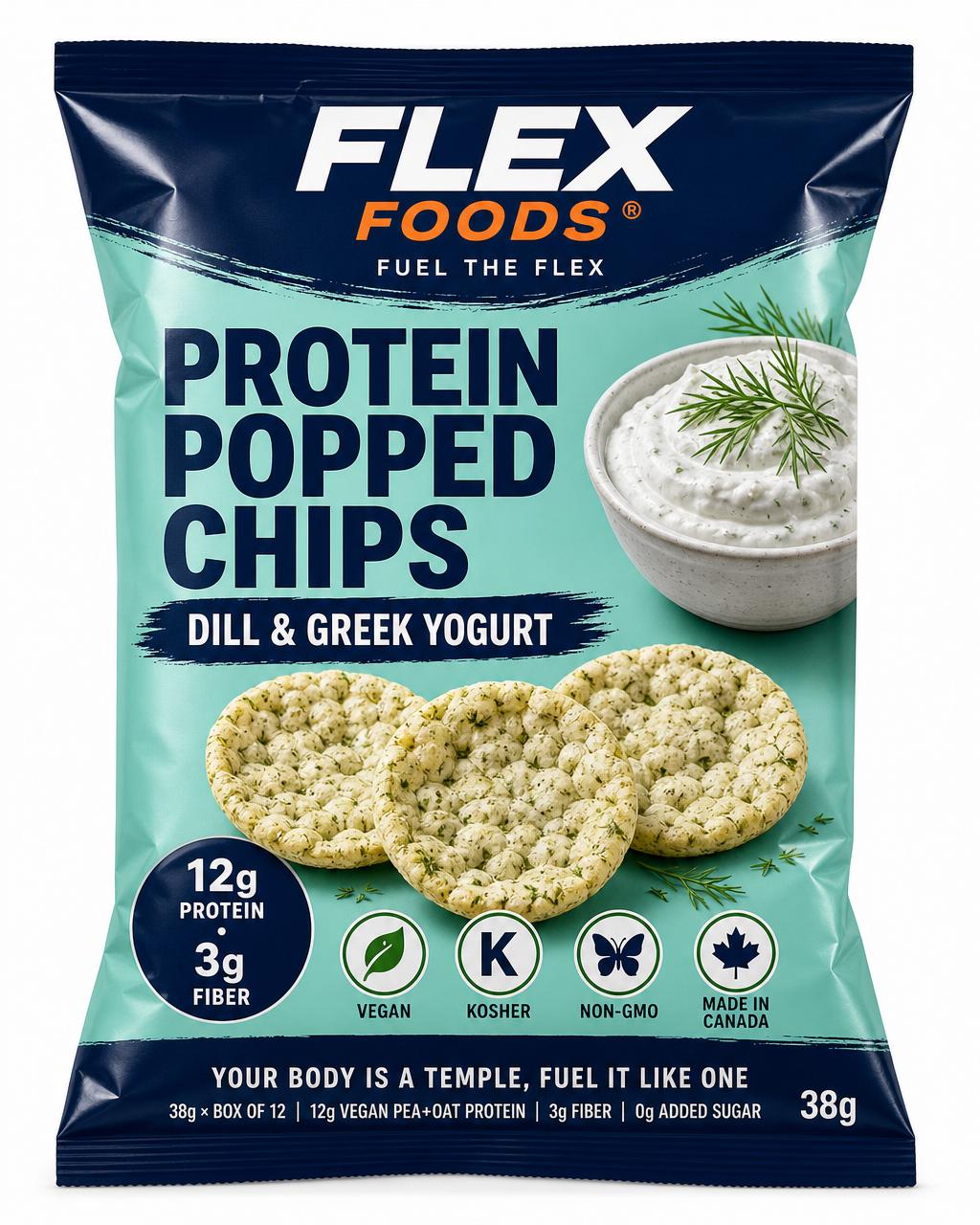
The snack row is 24 g, and 12 g of that is a 38 g bag of Protein Popped Chips. Being honest about the framing: the chips aren't doing the work in that day. The beans are cheaper and contribute the same amount.
What the chips do is occupy the slot where the realistic alternative isn't a tin of beans — it's a vending machine, or nothing. Snacks are where most people's daily protein leaks, and closing that leak with something convenient is a smaller intervention than it sounds but a reliable one.
When powder genuinely makes sense
Four situations where it's the better tool, and we'd say so.
1. High targets with low appetite. Someone at 90 kg targeting 2 g/kg needs 180 g daily. That's a lot of food volume, and plant proteins come with fibre that fills you up. A shake delivers 25 g with negligible fullness — which is exactly the point.
2. Bulking. The same low satiety that's a drawback when managing intake is an advantage in a surplus. Liquid calories are the easiest calories to consume past comfortable fullness. See clean calorie density.
3. Immediately post-training, twice-daily. If you're training again in a few hours, absorption speed has some practical value and appetite is often suppressed. Liquid wins on both.
4. Cost, at scale. Bulk pea or whey isolate typically works out to somewhere around 3–6 cents per gram of protein. That's cheaper than most convenience foods and competitive with whole-food sources. Against roughly 31 cents per gram for a single bag of our chips, powder wins that comparison decisively — and we're not going to pretend otherwise. Full ranking in cost per gram of protein.
When it doesn't
If you're already hitting your target. Extra protein beyond your requirement isn't stored as muscle. It's oxidised for energy or converted, and the marginal benefit approaches zero.
If you don't train. Protein supports a training stimulus. Without resistance training there's very little for the additional protein to do.
If you're using it to avoid cooking. Legitimate as an occasional thing, corrosive as a system. Whole-food protein sources bring fibre, micronutrients and phytochemicals that isolates don't, and a diet built on shakes is missing more than it looks.
The honest hierarchy
- Hit your daily total. Dominates everything else here.
- Train against resistance. Protein without a stimulus builds little.
- Spread it across three or four feedings. Worth a few percent — see protein distribution.
- Get most of it from whole foods. For the fibre and micronutrients, not because isolates are harmful.
- Use powder to fill gaps the first four leave open.
Most people who feel they need a supplement actually need a higher-protein breakfast and a protein-containing snack. That's a less profitable answer for everyone selling anything, us included.