
Training
Bulking Without Junk: Clean Calorie Density
Gaining weight is easy. Gaining it without wrecking your digestion, appetite and bloodwork takes a strategy.
The internet's answer to gaining weight is "dirty bulk" — eat everything, sort it out later. It works, in the narrow sense that you will gain weight.
What it also does is put on more fat than necessary, make the subsequent cut longer and harder, and often leave people feeling sluggish and inflamed for months. There's a more deliberate version.
The actual problem with gaining
Counterintuitively, the difficulty isn't discipline. It's appetite.
Eating in a surplus means eating past comfortable fullness, repeatedly, for months. And most of the foods that are good for you are specifically engineered by nature to be filling — high in fibre, high in water, low in energy density. Vegetables, legumes, whole grains and fruit are excellent food and terrible bulking food, because they fill you up before they've delivered many calories.
So the strategy is the mirror image of cutting. Where cutting maximises satiety per calorie, gaining minimises it — without abandoning food quality entirely.
How much surplus
Modest. Commonly cited guidance is a surplus in the range of 10–20% above maintenance, or roughly 300–500 calories a day, targeting weight gain of about 0.25–0.5% of bodyweight per week.
For a 70 kg person that's around 175–350 g a week. It feels slow. Faster gaining doesn't produce proportionally more muscle — the rate at which you can build muscle tissue is limited by training and recovery, not by how much you eat, so calories beyond that ceiling become fat.
Protein doesn't need to be dramatically high in a surplus. The commonly used 1.6 g per kilogram figure is adequate; there's little evidence that going much beyond that helps when energy is plentiful. Our guide to daily protein needs covers the ranges.
Energy density is the whole game
Calories per gram, and the spread is enormous:
| Food | Cal/g | Notes |
|---|---|---|
| Olive oil | 8.8 | Highest available. Add to everything. |
| Nut butter | 5.9 | Best calorie-to-effort ratio on this list |
| Almonds, walnuts | 5.8 | Easy to eat volumes of |
| Dried fruit | 3.2 | Carbohydrate, low satiety |
| Protein popped chips | 3.9 | Moderate, and 12 g protein per bag |
| White rice, cooked | 1.3 | Bulky but easy to eat a lot of |
| Oats, dry | 3.8 | Becomes very bulky once cooked |
| Potato, cooked | 0.9 | Extremely filling per calorie |
| Broccoli | 0.35 | Effectively anti-bulking |
The lesson isn't to stop eating vegetables. It's to stop letting them occupy the space where calories need to go. Eat them, but not first and not in enormous volume.
Six additions that don't require eating more meals
The most sustainable approach is making existing food more calorie-dense rather than adding a fifth meal.
- Olive oil, on everything. A tablespoon is 120 calories and disappears into a bowl of anything. The single most efficient move available.
- Nut butter in oats, smoothies and on toast. Two tablespoons is 190 calories and 8 g protein.
- Full-fat plant milk instead of unsweetened. Soy rather than almond — more protein and more calories.
- Cook grains in stock or plant milk rather than water. Free calories, better flavour, no extra volume.
- Dried fruit alongside nuts. Concentrated carbohydrate and fat together, minimal fullness.
- Liquid calories between meals. This is where liquid's low satiety becomes an advantage. A smoothie with oats, soy milk, nut butter and banana can clear 600 calories without touching your appetite for dinner.
Where snacks fit
Snacks are the practical mechanism, because adding calories to existing meals has a ceiling and adding whole meals is a chore.
Two or three snacks a day at 250–400 calories each covers most of a reasonable surplus. The main criterion is that they don't suppress your appetite for your actual meals.
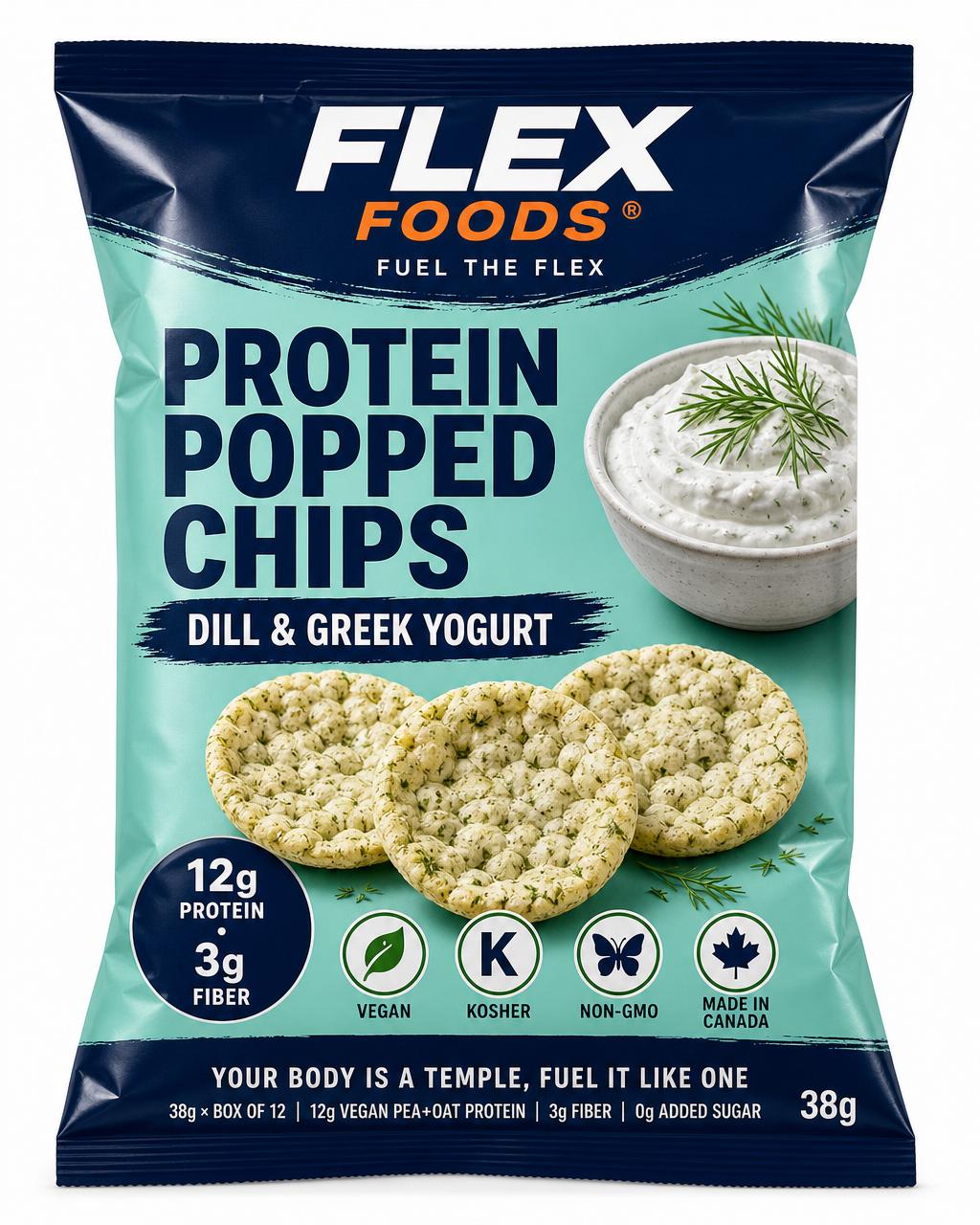
Where a protein snack fits: a 38 g bag of Protein Popped Chips is 150 calories and 12 g of protein — a moderate contribution on its own, useful as a base. Paired with a nut butter dip, hummus or added to a snack board it lands in the 300–400 range while contributing 20 g of protein. Combinations in nine high-protein pairings.
Honest note: at 3.9 calories per gram it's moderately energy-dense, not exceptionally so. Nuts and nut butter beat it substantially for pure calorie loading. Its advantage is that it's savoury and easy to eat when you're already full, which is a real constraint on a bulk.
Three things that go wrong
Fibre overload. Eating much more food means eating much more fibre, and a sudden large increase causes bloating, gas and discomfort that further suppresses appetite. Increase gradually and drink more water.
Losing track of the actual rate. Weigh yourself under the same conditions a few times a week and track the weekly average, not individual days. If you're gaining much faster than about 0.5% of bodyweight weekly, most of the excess is fat.
Neglecting the training. Calories don't build muscle. Progressive resistance training builds muscle and calories permit it. A surplus without a stimulus is just a surplus. See building muscle on a plant-based diet.