
On The Go
Airplane Snacks: What to Pack for a Long Flight
Security rules, cabin pressure and the etiquette of eating in a metal tube. What to bring on a long flight.
Airport food is expensive, mediocre and heavily skewed toward refined carbohydrate. Airline food, where it still exists, is worse. A five-hour flight with nothing packed reliably ends in a $14 sandwich and a slump somewhere over Manitoba.
Packing is easy once you know the actual constraints, most of which people get wrong.
What security actually allows
The rule most travellers half-remember is the liquids rule, and it applies to liquids, gels, aerosols and pastes — generally 100 ml or less per container in a single one-litre transparent bag for carry-on.
Solid food is not restricted. Sandwiches, chips, bars, nuts, fruit, dry cereal — all fine through security in domestic and international carry-on. This surprises people who've been dutifully leaving snacks at home.
The grey area is anything spreadable. Hummus, yogurt, nut butter and dips are treated as gels or pastes, so a full tub gets confiscated and a small sachet under the limit generally doesn't. If it can be spread, assume it's a liquid.
The separate issue is arrival, not departure. Agricultural restrictions on bringing food into a country are real and enforced — fresh fruit, vegetables, meat, dairy and seeds routinely get seized, and undeclared items can carry fines. Processed, commercially packaged shelf-stable snacks are the low-risk category, but declare food when asked and check the destination's rules if you're crossing a border.
The pressure thing, which is genuinely interesting
Sealed snack bags inflate on a plane. If you've noticed a bag of chips looking taut at cruising altitude, that's real physics rather than your imagination.
Aircraft cabins are pressurised to the equivalent of roughly 1,800–2,400 m of altitude, not sea level. The gas sealed inside a nitrogen-flushed snack bag was packed at ground pressure, so as external pressure drops the bag expands. Modern barrier films handle it, and bursting is rare — but a tightly packed bag pressing against a laptop corner can split.
Practical implication: pack sealed bags where nothing sharp is pressing on them, and expect them to take up more space at altitude than they did at the gate.
The same pressure change also affects taste. Reduced cabin pressure and very low humidity measurably dull perception of sweet and salty flavours — one reason airline food tastes flat and tomato juice inexplicably tastes better in the air. Aromatic, spiced and acidic foods hold up better than subtle ones. A boldly seasoned snack is genuinely the right choice on a plane.
The etiquette constraint
You're in a sealed cabin with recirculated air and a stranger's elbow six inches away. Two rules.
No strong smells. Tuna, boiled eggs, curry, durian, anything reheated. This is not squeamishness — it's a genuinely captive audience.
Manage noise. Crinkling a bag for twenty minutes on a red-eye is antisocial. Open it, decant into something quieter if you're eating over a long stretch, or eat it in one sitting during the day.
What to actually pack
The long-haul kit
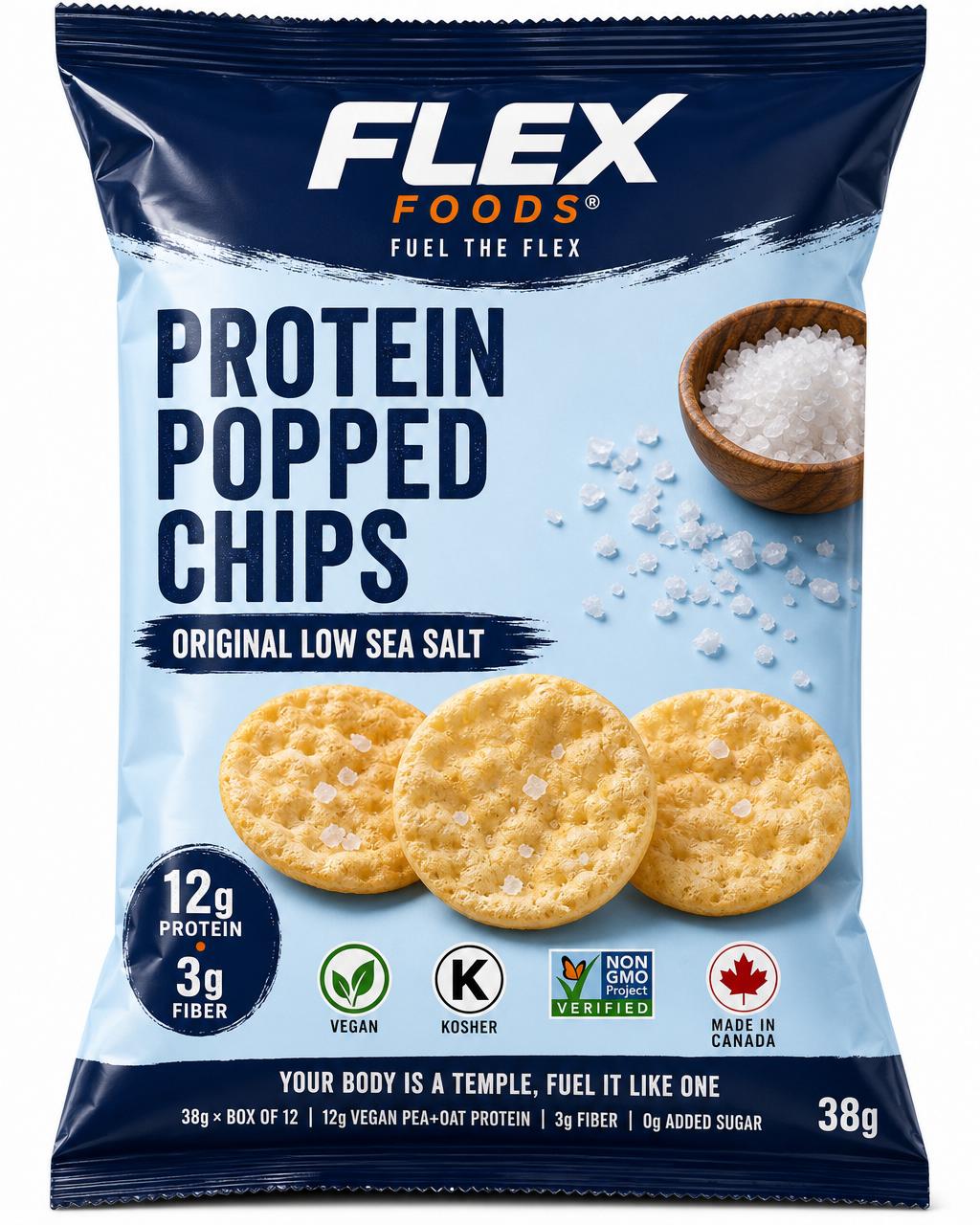
- Two protein-forward sealed snacks. Something with real protein and fibre so you're not riding a glucose spike at 35,000 feet. A 38 g bag of Protein Popped Chips is 150 calories, 12 g protein, 3 g fibre, 0 g added sugar — and boldly seasoned enough to survive the flavour-dulling effect described above.
- One protein bar. The dense insurance option for a delayed connection or a missed meal service. Crush-proof and compact.
- Nuts, a small portion. Calorie-dense, durable, no smell.
- One piece of fruit for the flight itself. Apple or orange — they survive a bag, and the water content helps. Eat it before you land if you're crossing a border.
- An empty water bottle. The single highest-value item. Fill it past security. Cabin humidity often sits below 20%, and dehydration accounts for a large share of how bad you feel after a long flight.
What not to bother with
- Anything needing refrigeration, unless the flight is short
- Full-size dips, spreads or yogurt — confiscated as gels
- Chocolate on a warm route; it melts in an overhead bin
- Large volumes of anything. You're less active than usual and eating out of boredom is the default failure mode.
The timing question on long flights
If you're crossing several time zones, there's a reasonable argument for aligning eating with your destination rather than your departure — light at the destination's night, a proper meal at the destination's morning. Evidence on meal timing as a jet-lag intervention is suggestive rather than settled, and light exposure appears to matter more, but it costs nothing to try.
The more reliable advice is unexciting: eat less than the service offers, drink more water than feels necessary, and keep one protein snack in reserve for the moment the connection gets delayed. That last one has saved more travellers than any circadian strategy.
For the ground-transport equivalent, see road-trip snacking across Canada.